
Showing posts with label Fatih Akin. Show all posts
Showing posts with label Fatih Akin. Show all posts
Sunday, May 20, 2012
Polluting Paradise: Cannes Review
Environmental doc is explicitly much more a campaigning tool than any kind of objective reportage.
Prolific Turkish-German auteur Fatih Akin aims to raise a stink with Polluting Paradise, a heartfelt documentary chronicling the environmental mismanagement blighting his grandparents' home village.
Co-produced by a German TV channel, this is informative, ire-stoking but formally conventional small-screen fare whose only theatrical prospects are domestic, where Akin's ensemble comedy Soul Kitchen was 2009's second-biggest home-grown hit. Exposure abroad via eco-themed festivals and networks will nevertheless flow from an Out of Competition premiere at Cannes, where Akin's 2007 The Edge of Heaven took Best Screenplay.
Akin is quite unusual among major European film-makers in that he's harvested such major awards -- including Berlinale's Golden Bear for Head-On -- and critical praise as well as significant box-office success. An occasional documentarian, whose non-fiction movies tend to spring from his features, he now uses his status as a bully-pulpit to help raise awareness of a specific issue unfolding over the last half-decade on the Black Sea coast.
PHOTOS: Cannes 2012: Opening Night Gala
Polluting Paradise (Müll im Garten Eden), filmed over the last five years since Akin came to the area to shoot parts of Edge of Heaven, is thus explicitly much more a campaigning tool than any kind of objective reportage. It's evident that Akin is firmly on the side of the villagers in Çamburnu, a picturesque settlement located beneath lush tea-growing slopes. In 2007 a former copper-mine a couple of miles uphill was turned into an enormous landfill for the entire Trabzon province's trash - amid much local protest. The opposition has remained vociferous over the years -- thanks partly to the powerful stench emitted by the supposedly "odorless" garbage and, even more economically damaging, the deleterious effect on streams and the water-table.
Often working in collaboration with local-historian Bünyamin Seyrekbasan, whose photographs and video-recordings comprise an exhaustive and invaluable archive of the case, Akin sympathetically catalogues the complaints of numerous residents. Crucially, Akin and his collaborators obtain great access to the site and its surroundings, frequently happening to be in the right place at exactly the right time. They can thus capture the often-fraught encounters between the locals and the hapless functionaries tasked with operating and maintaining this deeply unpopular facility -- images of which are often given a sinister cast by the thriller-type stylizations of Alexander Hacke's over-used score.
The village's mayor is also a frequent on-camera presence, having pluckily spearheaded resistance to a scheme devised and implemented by the seldom-seen officials of the regional and national government. Mouthpiece for the latter is the plant's blandly reassuring manager ("the earth will sort it out") - but Polluting Paradise never quite manages to point a steady finger of blame at any one individual or department, and there's no indication that Akin tried to contact higher-up decision-makers.
Then again, a confrontational, attention-hogging Michael Moore approach clearly isn't his style -- as well as an amplification of grievances, Polluting Paradise is often a lyrical tribute to places and people with whom the Hamburg-raised director evidently feels a strong affinity. Akin's own family left Çamburnu long ago, of course -- and the village's population has been quickly dwindling as young people seek better opportunities and less smelly surroundings. Their relocation to Turkey's major cities -- whose own infrastructure is thus placed under extra stress - is symptomatic of a planet-wide flight from the rural to the urban. And it's sobering to reflect that there are probably hundreds of Çamburnus all around the world, small-scale eco-disasters proceeding far the purviews of world cinema's beady eyes.
Venue: Cannes Film Festival (Out of Competition - Special Screenings), May. 18, 2012.
Production company: Corazón International, in coproduction with NDR and Dorje Film
Director / Screenwriter: Fatih Akin
Producers: Fatih Akin, Klaus Maeck, Alberto Fanni, Flaminio Zadra, Paolo Colombo
Directors of photography: Bünyamin Seyrekbasan, Hervé Dieu
Music: Alexander Hacke
Editor: Andrew Bird
Sales Agent: The Match Factory, Cologne
No rating, 97 minutes.


Saturday, October 10, 2009
The Children of Diyarbakir / Min dit

MIN DIT has been awarded with the "Gaztea Youth Award" of the San Sebastian Filmfestival
Reviewed at San Sebastian
The Children of Diyarbakir / Min dit (Germany/Turkey)
By JAY WEISSBERG
A Bezar Film, Corazon Intl. production. (International sales: the Match Factory, Cologne.) Produced by Miraz Bezar. Co-producers, Klaus Maeck, Fatih Akin. Directed, written, edited by Miraz Bezar.
With: Senay Orak, Muhammed Al, Hakan Karsak, Suzan Ilir, Berivan Ayaz, Fahriye Celik, Alisan Onlu, Berivan Eminoglu, Mehmet Inci, Cekdar Korkusuz, Recep Ozer.
(Kurdish, Turkish dialogue)
An extraordinary performance by a 10-year-old girl anchors "The Children of Diyarbakir," the debut feature of Miraz Bezar. Set in the predominantly Kurdish city of Diyarbakir, Turkey, the pic takes a straightforward, non-sensationalized approach to the tragic story of a brother and sister orphaned when their parents are assassinated by a secret-services paramilitary officer. Though it shows its first-feature origins, the film has moments, especially toward the end, that so transcend the material as to make the journey doubly worthwhile. A healthy fest life is assured, while Euro arthouse play isn't out of the question.
Though less inspired, the early scenes do the necessary work of introducing characters and establishing a mood: Gulistan (Senay Orak) and her younger brother, Firat (Muhammed Al), have a normal childhood with their mom (Fahriye Celik) and dad (Alisan Onlu) and new baby brother. Dad is a Kurdish journalist; on their way back from a wedding, the family is stopped by three gunmen, who shoot the parents dead in front of the kids. The brief scene is all the more powerful because Bezar downplays any excess in either the lensing or editing.
The kids' aunt Yekbun (Berivan Eminoglu), an underground Kurdish activist, moves in to care for them, but as she tries to get a visa to take them to their grandpa in Sweden, she's kidnapped by the paramilitary police and the children are left completely alone. As the weeks pass, they start selling everything in the apartment just to have food to eat, but it's not enough for medicine for the baby.
Kicked out of their home, Gulistan and Firat meet worldly-wise street kid Zelal (Suzan Ilir), who teaches them the basics of survival. Gulistan is also befriended by Dilara (Berivan Ayaz), a prostitute who uses her as a cover but genuinely cares about the young girl. When Firat sees one of their parents' killers, Nuri (Hakan Karsak), the boy is paralyzed by fear; in the days that follow, the paths of the two children, along with those of Dilara and Nuri, will all intersect in ways that have surprising impact due to the unexpected restraint with which they're played.
It's precisely Bezar's ability to hold back that allows this street-orphan tale to rise above the usual treatment of the subject. Bezar (born in Turkey, raised in Germany) keeps the kids as real as possible without turning them into merely cute sympathy magnets; he also reveals a city in all its multiple facets, from dying neighborhoods to leafy residential sections where the privileged live, unmoved by or apathetic toward Kurdish repression.
The cast of mostly unknowns can be uneven, but Orak is haunting as 10-year-old Gulistan. With large brown eyes taking in everything around her, this young nonpro is astonishingly real as she searches for ways to get herself and her brother through each day.
Fatih Akin boarded as co-producer through his production house, Corazon Intl., after Bezar showed him a rough cut. Tech credits reflect the modest budget, and the transfer from HD can't disguise a certain flatness in lighting, but the overall look is more than acceptable. Presumably, the final rap song was chosen for its message and thus requires subtitling.
Camera (color, widescreen, HD-to-35mm), Isabelle Casez; music, Mustafa Biber; production designer, Pinar Soydinc; costume designer, Ozlem Batur; sound (Dolby Digital), Garip Ozden, Daniel Weis; associate producers, Saliha Kutlay, Flaminio Zadra. Reviewed at San Sebastian Film Festival (Zabaltegi New Directors), Sept. 22, 2009. Running time: 101 MIN.
Saturday, September 12, 2009
Review | Soul Kitchen
Venice
Soul Kitchen (Germany)
By DEREK ELLEY
A Pandora Film release of a Corazon Intl. production, in association with Pyramide Prods., NDR, Dorje Film. (International sales: the Match Factory, Cologne.) Produced by Klaus Maeck, Fatih Akin. Co-producers, Fabienne Vonier, Alberto Fanni, Flaminio Zadra, Paolo Colombo. Directed by Fatih Akin. Screenplay, Akin, Adam Bousdoukos.
With: Adam Bousdoukos, Moritz Bleibtreu, Birol Unel, Anna Bederke, Pheline Roggan, Lucas Gregorowicz, Dorka Gryllus, Wotan Wilke Moehring, Demir Gokgol, Monica Bleibtreu, Udo Kier, Marc Hosemann, Cem Akin, Catrin Striebeck, Jan Fedder, Julia Wachsmann, Markus Imboden, Gudrun Egner, Gustav Peter Woehler, Ugur Yucel.
Returning to his native Hamburg, Turkish-German filmmaker Fatih Akin rediscovers the verve of his early "Short Sharp Shock," tempered by a mature warmth, in "Soul Kitchen." Nicely cast ensembler, centered on a hopelessly disorganized eatery owner and peopled by a weird collection of lovable eccentrics, is pacey entertainment that hardly puts a foot wrong. This is not the fest-laureled Akin of weighty fare like "Head-On" and "The Edge of Heaven" -- more the one of "Solino" with a grungy, down-to-earth Hamburg edge. Offshore sales, at least in Europe, look to be lively.
Clearly made as a change of pace after "Heaven," the pic is labeled by Akin "an audacious, dirty Heimat film." But for him, a Heimat film isn't Bavarian blondes in dirndls; this is northern, grungy, multikulti Germany, with Greeks, Turks, rock bands and drifters.
Zinos Kazantsakis (Greek-German thesp Adam Bousdoukos) owns and caters a warehouse restaurant in the Hamburg nabe of Wilhelmsburg, where the working-class clientele like deep-fried schnitzels and burgers with their beer. Always running behind the eight-ball, Zinos even arrives late for the farewell dinner of his better-off g.f., Nadine (Pheline Roggan), who's leaving for a job in Shanghai.
When Zinos' larcenous younger brother, Illias (Moritz Bleibtreu), is let out of jail on day release, he asks Zinos to give him a fake job so he can get out more often. Zinos also has the idea of hiring a professional chef, the temperamental Shayn (Birol Unel), whose nouvelle cuisine alienates his regulars but eventually becomes a hit with the in-crowd.
With a tax inspector (Catrin Striebeck) and health officer (Jan Fedder) on his back, Nadine nagging him long-distance to join her, and a real estate shark (Wotan Wilke Moehring) trying to force him to sell the place, Zinos signs power of attorney over to the unreliable Illias and decides to set off to China. But he doesn't get further than the airport.
Incident-packed script manages to juggle a large number of characters and cameos without leaving any of them feeling underdeveloped. As the pieces fall into place in the final reels, there's a nice sense of community among the group of dreamers, losers and getting-byers, a feeling of how "home" is where you're most comfortable rather than a specific country, culture or place.
Bousdoukos, who co-wrote the script with Akin and was in the helmer's "Short Sharp Shock," has a slightly goofy, dumbkopf appeal that's just right for Zinos, and he teams well with Bleibtreu as his younger brother. Moehring and Unel are fine as the property trader and prima donna chef, respectively, but the real discovery is Hamburg-born Anna Bederke as Lucia, Zinos' hard-drinking waitress, who, in a beautifully played sequence, falls hard for Illias. As Zinos' physical therapist, Anna, Hungarian thesp Dorka Gryllus ("Irina Palm") is also aces in a key but gentler role.
Though several sequences feature cuisine, "Soul Kitchen" is not a foodie film a la "Mostly Martha." Music, just as much as food, is the way into the souls of these characters, but the rough-edged city of Hamburg -- always there in the background -- is what brings them together. Pic is as much a love letter to the place as to its people.
Technical package is deliberately on the grungy side but blooms when necessary under the camera of Akin regular Rainer Klausmann. Tight editing by Andrew Bird brings the pic in at a flab-free 98 minutes, and end titles are especially inventive.
The film is dedicated to Akin's brother, Cem, who plays one of Illias' buddies. It also features one of the last performances of Bleibtreu's mother, Monica (who died in May), in a comically explosive cameo as Nadine's grandma.
Camera (color), Rainer Klausmann; editor, Andrew Bird; music supervisors, Klaus Maeck, Pia Hoffmann; production designer, Tamo Kunz; costume designer, Katrin Aschendorf; sound (Dolby Digital), Kai Luede, Richard Borowski; sound designer, Andreas Hildebrandt; casting, Monique Akin. Reviewed at Venice Film Festival (competing), Sept. 10, 2009. (Also in Toronto Film Festival -- Special Presentations.) Running time: 98 MIN.
Soul Kitchen (Germany)
By DEREK ELLEY
A Pandora Film release of a Corazon Intl. production, in association with Pyramide Prods., NDR, Dorje Film. (International sales: the Match Factory, Cologne.) Produced by Klaus Maeck, Fatih Akin. Co-producers, Fabienne Vonier, Alberto Fanni, Flaminio Zadra, Paolo Colombo. Directed by Fatih Akin. Screenplay, Akin, Adam Bousdoukos.
With: Adam Bousdoukos, Moritz Bleibtreu, Birol Unel, Anna Bederke, Pheline Roggan, Lucas Gregorowicz, Dorka Gryllus, Wotan Wilke Moehring, Demir Gokgol, Monica Bleibtreu, Udo Kier, Marc Hosemann, Cem Akin, Catrin Striebeck, Jan Fedder, Julia Wachsmann, Markus Imboden, Gudrun Egner, Gustav Peter Woehler, Ugur Yucel.
Returning to his native Hamburg, Turkish-German filmmaker Fatih Akin rediscovers the verve of his early "Short Sharp Shock," tempered by a mature warmth, in "Soul Kitchen." Nicely cast ensembler, centered on a hopelessly disorganized eatery owner and peopled by a weird collection of lovable eccentrics, is pacey entertainment that hardly puts a foot wrong. This is not the fest-laureled Akin of weighty fare like "Head-On" and "The Edge of Heaven" -- more the one of "Solino" with a grungy, down-to-earth Hamburg edge. Offshore sales, at least in Europe, look to be lively.
Clearly made as a change of pace after "Heaven," the pic is labeled by Akin "an audacious, dirty Heimat film." But for him, a Heimat film isn't Bavarian blondes in dirndls; this is northern, grungy, multikulti Germany, with Greeks, Turks, rock bands and drifters.
Zinos Kazantsakis (Greek-German thesp Adam Bousdoukos) owns and caters a warehouse restaurant in the Hamburg nabe of Wilhelmsburg, where the working-class clientele like deep-fried schnitzels and burgers with their beer. Always running behind the eight-ball, Zinos even arrives late for the farewell dinner of his better-off g.f., Nadine (Pheline Roggan), who's leaving for a job in Shanghai.
When Zinos' larcenous younger brother, Illias (Moritz Bleibtreu), is let out of jail on day release, he asks Zinos to give him a fake job so he can get out more often. Zinos also has the idea of hiring a professional chef, the temperamental Shayn (Birol Unel), whose nouvelle cuisine alienates his regulars but eventually becomes a hit with the in-crowd.
With a tax inspector (Catrin Striebeck) and health officer (Jan Fedder) on his back, Nadine nagging him long-distance to join her, and a real estate shark (Wotan Wilke Moehring) trying to force him to sell the place, Zinos signs power of attorney over to the unreliable Illias and decides to set off to China. But he doesn't get further than the airport.
Incident-packed script manages to juggle a large number of characters and cameos without leaving any of them feeling underdeveloped. As the pieces fall into place in the final reels, there's a nice sense of community among the group of dreamers, losers and getting-byers, a feeling of how "home" is where you're most comfortable rather than a specific country, culture or place.
Bousdoukos, who co-wrote the script with Akin and was in the helmer's "Short Sharp Shock," has a slightly goofy, dumbkopf appeal that's just right for Zinos, and he teams well with Bleibtreu as his younger brother. Moehring and Unel are fine as the property trader and prima donna chef, respectively, but the real discovery is Hamburg-born Anna Bederke as Lucia, Zinos' hard-drinking waitress, who, in a beautifully played sequence, falls hard for Illias. As Zinos' physical therapist, Anna, Hungarian thesp Dorka Gryllus ("Irina Palm") is also aces in a key but gentler role.
Though several sequences feature cuisine, "Soul Kitchen" is not a foodie film a la "Mostly Martha." Music, just as much as food, is the way into the souls of these characters, but the rough-edged city of Hamburg -- always there in the background -- is what brings them together. Pic is as much a love letter to the place as to its people.
Technical package is deliberately on the grungy side but blooms when necessary under the camera of Akin regular Rainer Klausmann. Tight editing by Andrew Bird brings the pic in at a flab-free 98 minutes, and end titles are especially inventive.
The film is dedicated to Akin's brother, Cem, who plays one of Illias' buddies. It also features one of the last performances of Bleibtreu's mother, Monica (who died in May), in a comically explosive cameo as Nadine's grandma.
Camera (color), Rainer Klausmann; editor, Andrew Bird; music supervisors, Klaus Maeck, Pia Hoffmann; production designer, Tamo Kunz; costume designer, Katrin Aschendorf; sound (Dolby Digital), Kai Luede, Richard Borowski; sound designer, Andreas Hildebrandt; casting, Monique Akin. Reviewed at Venice Film Festival (competing), Sept. 10, 2009. (Also in Toronto Film Festival -- Special Presentations.) Running time: 98 MIN.
Friday, July 31, 2009
Venice 2009 | Soul Kitchen by Fatih Akin

Turkish-German helmer Fatih Akin’s “Soul Kitchen,” which had been put on the back burner while “The Edge of Heaven” was pushed into production, is cooking once more.
The Hamburg-set romantic comedy, which was first unveiled in 2004, has been handed E3.2 million ($5.1 million) in production support by German funding org FFA in May 2008 session and will debut as part of the International competition of feature films, presented as world premieres at the 66. Mostra Internazionale d'Arte Cinematografica in Venice (2-12 settembre 2009) which is under the direction of Marco Müller for the fifth consecutive year.
The Jury of Venezia 66 will be chaired by Ang Lee and composed of: Sandrine Bonnaire,Liliana Cavani, Joe Dante, Anurag Kashyap and Luciano Ligabue.
Fatih Akin Reunites With HEAD ON’s Birol Ünel For Soul Kitchen, which is a comedy that also stars Moritz Bleibtreu and Alexandra Maria Lara. The Hamburg-set romantic comedy tells the story of Greek bar owner Zinos (Adam Bousdoukos) who has a relationship with a basketball player from Serbia, while attempting to keep his restaurant in business as Akin returns to his favorite themes of culture and gender clash. It has been described as a love song to Hamburg and Akin's home town Film fest (Sept. 24-Oct. 3) is also set to run "Soul Kitchen".
Distributor Pandora will bow the film in Germany on Christmas Day. The Match Factory is selling "Soul Kitchen" worldwide.
Friday, December 19, 2008
Review | Crossing The Bridge: The Sound Of Istanbul
Crossing The Bridge: The Sound Of Istanbul
by Sheri Linden
posted August 1, 2008 10:00 AM
Turkish-German filmmaker Fatih Akin follows up Berlin fest prize winner "Head On" with this valentine to Istanbul. The city's fusion of East and West, traditional and modern is evident in the assortment of musicians who perform for Akin's cameras. They all make vivid impressions in the exuberant "Crossing the Bridge: The Sound of Istanbul," but the multi-subject approach dilutes the impact of the film.
German bassist Alexander Hacke, who fell for the Turkish city while recording songs for "Head On," is the tour guide on this musician's-eye view of the metropolis. The scruffy musicologist sometimes sits in with the groups he records, among them psychedelic underground band Baba Zula. More often than not he's beaming from the sidelines, whether at hip-hop artists, rock bands Duman and Replikas, anti-corporate buskers or veteran performers like chanteuse Sezen Aksu, who increasingly blends regional traditions into her pop brew. The marriage of European and Asian influences echoes throughout the film. Composer and onetime movie star Orhan Gencebay (seen in scratchy clips from '70s action flicks) alarmed conservatives when he incorporated Egyptian and Western techniques into the music he plays on the saz, a type of lute. Clarinetist Selim Sesler's reed wails with Romany-influenced plaintive joy, reminiscent of klezmer.
The film touches upon cultural and political issues, not least the Turkish government's recently lifted ban on the Kurdish language. Even so, "Crossing the Bridge" is resolutely celebratory. Varied settings--boat, café, park, ancient spa--provide a rich visual backdrop, and judiciously used vintage clips offer intriguing glimpses of Istanbul through the years. Directed and written by Fatih Akin. Produced by Fatih Akin, Klaus Maeck, Andreas Thiel, Sandra Harzer-Kux and Christian Kux. A Strand release. Documentary. Turkish- and German-language; subtitled. Unrated. Running time: 90 min
by Sheri Linden
posted August 1, 2008 10:00 AM
Turkish-German filmmaker Fatih Akin follows up Berlin fest prize winner "Head On" with this valentine to Istanbul. The city's fusion of East and West, traditional and modern is evident in the assortment of musicians who perform for Akin's cameras. They all make vivid impressions in the exuberant "Crossing the Bridge: The Sound of Istanbul," but the multi-subject approach dilutes the impact of the film.
German bassist Alexander Hacke, who fell for the Turkish city while recording songs for "Head On," is the tour guide on this musician's-eye view of the metropolis. The scruffy musicologist sometimes sits in with the groups he records, among them psychedelic underground band Baba Zula. More often than not he's beaming from the sidelines, whether at hip-hop artists, rock bands Duman and Replikas, anti-corporate buskers or veteran performers like chanteuse Sezen Aksu, who increasingly blends regional traditions into her pop brew. The marriage of European and Asian influences echoes throughout the film. Composer and onetime movie star Orhan Gencebay (seen in scratchy clips from '70s action flicks) alarmed conservatives when he incorporated Egyptian and Western techniques into the music he plays on the saz, a type of lute. Clarinetist Selim Sesler's reed wails with Romany-influenced plaintive joy, reminiscent of klezmer.
The film touches upon cultural and political issues, not least the Turkish government's recently lifted ban on the Kurdish language. Even so, "Crossing the Bridge" is resolutely celebratory. Varied settings--boat, café, park, ancient spa--provide a rich visual backdrop, and judiciously used vintage clips offer intriguing glimpses of Istanbul through the years. Directed and written by Fatih Akin. Produced by Fatih Akin, Klaus Maeck, Andreas Thiel, Sandra Harzer-Kux and Christian Kux. A Strand release. Documentary. Turkish- and German-language; subtitled. Unrated. Running time: 90 min
Review | Distant (uzak)
Distant (uzak)
by Shlomo Schwartzberg
posted August 1, 2008 10:00 AM
Urban meets rural when two cousins reconnect in modern Istanbul in Nuri Bilge Ceylan's intelligent but dry Cannes award winner. Well-established photographer Mahmut (Muzaffer Ozdemir) leads a prosperous but lonely existence in the city. Enter his newly unemployed village cousin Yusuf (Mehmet Emin Toprak), who wants to sign up on board a ship and sail the world. Mahmut cautions him against false hopes but otherwise doesn't do much to help his cousin, nor does he really want him around. Yusuf, for his part, doesn't respect Mahmut's house rules and friction between the two men quickly comes to the fore. The irony is that both men are more alike than they will admit.
While the two leads richly deserved the Best Actor award they shared at Cannes (posthumously in the case of Toprak, who died tragically in a car accident just after the film's completion), director Nuri Bilge Ceylan fails to build on the emotional undercurrents present in the script. "Distant" actually lives up to its title; it's a muted, uninvolving film. Starring Muzaffer Ozdemir, Mehmet Emin Toprak and Zuhal Gencer. Directed, written and produced by Nuri Bilge Ceylan. A New Yorker release. Drama. Turkish-language; subtitled. Unrated. Running time: 110 min
by Shlomo Schwartzberg
posted August 1, 2008 10:00 AM
Urban meets rural when two cousins reconnect in modern Istanbul in Nuri Bilge Ceylan's intelligent but dry Cannes award winner. Well-established photographer Mahmut (Muzaffer Ozdemir) leads a prosperous but lonely existence in the city. Enter his newly unemployed village cousin Yusuf (Mehmet Emin Toprak), who wants to sign up on board a ship and sail the world. Mahmut cautions him against false hopes but otherwise doesn't do much to help his cousin, nor does he really want him around. Yusuf, for his part, doesn't respect Mahmut's house rules and friction between the two men quickly comes to the fore. The irony is that both men are more alike than they will admit.
While the two leads richly deserved the Best Actor award they shared at Cannes (posthumously in the case of Toprak, who died tragically in a car accident just after the film's completion), director Nuri Bilge Ceylan fails to build on the emotional undercurrents present in the script. "Distant" actually lives up to its title; it's a muted, uninvolving film. Starring Muzaffer Ozdemir, Mehmet Emin Toprak and Zuhal Gencer. Directed, written and produced by Nuri Bilge Ceylan. A New Yorker release. Drama. Turkish-language; subtitled. Unrated. Running time: 110 min
Review | Head-on
Head-on
by Susan Green
posted August 1, 2008 10:00 AM
The intensity gives way to only brief glimpses of humor or tenderness in "Head-On," as much a cautionary tale about obsession as it is a sociological commentary on the clash of cultures. Fatih Akin's seamless film, which earned a Golden Bear at the 2004 Berlinale, never settles for the ordinary. The 40-year-old Cahit (a mesmerizing Birol Unel) appears to be a hopeless alcoholic bent on killing himself with booze. But unlike Nicolas Cage's over-the-top drunk in "Leaving Las Vegas," this long-haired Turkish immigrant living in Hamburg slowly and subtly peels away layers of anguish.
When an inebriated Cahit smashes his car into a brick wall, he survives but winds up in a mental hospital. His self-pity is interrupted by Sibel (Sibel Kekilli), a presumably suicidal patient who immediately proposes to him. There's plenty of method to her madness. A secret hedonist, she wants to escape the suffocating Middle Eastern code of behavior that her partially assimilated family insists a Muslim girl must follow. If she continues carousing, Sibel risks an honor killing at the hands of her older brother. The perfect solution might be a marriage of convenience to a Turk, who happens to be twice her age, with no romantic or carnal notions about the arrangement. And a woman is always her husband's property in the Old World way of thinking, so the in-laws will butt out.
In return for a loveless wedding, Sibel promises to keep Cahit in beer. At first, the situation seems ideal. She goes out dancing every night and sleeps with a succession of strangers. He drinks and engages in periodic sex with Maren (Catrin Striebeck), a hairdresser who has known him for some time. Naturally, everything changes. That's when the wrenching consequences of their illusions catch up with these tormented creatures. Starring Birol Unel, Sibel Kekilli, Catrin Striebeck, Guven Kirac, Cem Akin, Aysel Iscan, Demir Gokgol and Stefan Gebelhoff. Directed and written by Fatih Akin. Produced by Ralph Schwingel and Stefan Schubert. A Strand release. Drama. German- and Turkish-language; subtitled. Rated R for strong graphic sexuality, pervasive language, some brutal violence and drug content. Running time: 123 min
by Susan Green
posted August 1, 2008 10:00 AM
The intensity gives way to only brief glimpses of humor or tenderness in "Head-On," as much a cautionary tale about obsession as it is a sociological commentary on the clash of cultures. Fatih Akin's seamless film, which earned a Golden Bear at the 2004 Berlinale, never settles for the ordinary. The 40-year-old Cahit (a mesmerizing Birol Unel) appears to be a hopeless alcoholic bent on killing himself with booze. But unlike Nicolas Cage's over-the-top drunk in "Leaving Las Vegas," this long-haired Turkish immigrant living in Hamburg slowly and subtly peels away layers of anguish.
When an inebriated Cahit smashes his car into a brick wall, he survives but winds up in a mental hospital. His self-pity is interrupted by Sibel (Sibel Kekilli), a presumably suicidal patient who immediately proposes to him. There's plenty of method to her madness. A secret hedonist, she wants to escape the suffocating Middle Eastern code of behavior that her partially assimilated family insists a Muslim girl must follow. If she continues carousing, Sibel risks an honor killing at the hands of her older brother. The perfect solution might be a marriage of convenience to a Turk, who happens to be twice her age, with no romantic or carnal notions about the arrangement. And a woman is always her husband's property in the Old World way of thinking, so the in-laws will butt out.
In return for a loveless wedding, Sibel promises to keep Cahit in beer. At first, the situation seems ideal. She goes out dancing every night and sleeps with a succession of strangers. He drinks and engages in periodic sex with Maren (Catrin Striebeck), a hairdresser who has known him for some time. Naturally, everything changes. That's when the wrenching consequences of their illusions catch up with these tormented creatures. Starring Birol Unel, Sibel Kekilli, Catrin Striebeck, Guven Kirac, Cem Akin, Aysel Iscan, Demir Gokgol and Stefan Gebelhoff. Directed and written by Fatih Akin. Produced by Ralph Schwingel and Stefan Schubert. A Strand release. Drama. German- and Turkish-language; subtitled. Rated R for strong graphic sexuality, pervasive language, some brutal violence and drug content. Running time: 123 min
Review | The Edge of Heaven
The Edge of Heaven
by Matthew Nestel
Print Article
posted May 22, 2008 6:20 PM
Heaven makes for an enchanting brew
An ode to youth and homelands, this fictional tale lives up to its searing title. Yeter (Nursel Kose) is a prostitute by day and a mother always. She gambles on a degenerate widowed john who can’t handle his drink. His got-it-together German lit professor son Nejat (Baki Davrak) is well endowed with principal and purpose despite the chaos that comes knocking on his door. Add a couple of doe-eyed females chasing love against all odds, and it all steeps an enchanting brew that holds on the tongue and will draw heaps of folks back to their seats for seconds.
Time is tweaked throughout the film. We begin at the present but work backwards and forwards and then backwards again, only to return to the start. It’s a device that some filmmakers can get too carried away with. Luckily, writer/director Faith Akin lets the storyline and the characters captain this edifying journey involving several concentrically circled plots chaptered by some of their deaths.
It could have been any one of the fleshy call girls standing front and center behind a glass pane along a Hamburg red light district stretch. But Ali (Tuncel Turkiz) saw Yeter, and that was enough. She’s a Turk and so is he. But conversation tickles beyond the same old chitchat, and after a few turns in the sack Ali’s offering her a chance to leave the trick life and live and sleep with him alone. Given the perils of her trade, the Turkish transplant takes the bait.
Meantime in Turkey, her prized rebel daughter Ayten exists under the safe pretense that her mother vends shoes not sex. Seeking asylum from Turkey for her unfavorable political beliefs, she ditches out of town to avoid a fated prison sentence. Soon enough, Ayten sours on the resistance movement and lucks onto a naïve linguistics student at a Hamburg university named Lotte. The two become more than friends and perturb Lotte’s self-righteous mom. Once the law catches up with Ayten, Lotte is forced to abandon the comforts of subsidies. Her mother pulls the plug altogether, tossing her daughter into the throes of survival.
The rest of the film is a sort of collection of chance encounters—some that happen and others that could have happened. Each character, despite the end result, shares the striving for this ultimate oasis. Stumbling on a beggar may change your life for good or worse. A hooker sometimes has more scruples than the lot of goody two shoes. And despite the attraction to denounce parent or child, there is an unbridled sense that a connection is there and must be taken for more than face value.
Narrative is too often discounted for not being real enough to conjure humanity’s discourse. At times, this is fair. Here, the filmmaker took out the tracings of fat and honed in very deliberately on what makes these people tick. The characters and the emotions of the various cities are pinpointed with precision, putting to rest much of the tone-deaf predecessors that attempt the same but riddle with hollowed bullets of thought that just sit like an apple box on the dressed set.
B-roll shots are masterful. Driving along the outskirts of Turkey, there are the screaming skies, the awing sea, the beautiful chaos on city squares and bus roundabouts. Day and night. See an elderly farmer gathering olives and nuts, a saz-playing man on a hill whose notes backdrop the green rolling hills. You get the sense that Akin has stood on the grounds of these places for long lengths and knew the pulse of each because every shot hits.
Words are not always needed, and the writer in Akin let the sounds and visuals make their noises with grace. There is tragedy in this film, and many missed opportunities that could have salvaged a happier end. Ali, the scumbag pop, gets wily with the liquor, and despite a heart attack he manages to land himself in the clink. He even outlives some of the youths in the film. The seed is planted for son and father to reconcile away from Germany, in a remote spot in Turkey. Ayten ventures out to find her mother, and instead finds another unsuspecting guardian.
The film’s focus is a tad obscured by the political injections that make their point and yet there is mistakenly a need to fasten a wider bit to drill it into the heads of the viewer. Much of the “up yours” to bureaucracy is superfluous.
This picture summits difficult terrain. Though uneasy to think about all the frayed ends left here, that’s just what gives it so much oomph. No pretty bows, just a bunch of twisted knots and mangled braids and the sight of it all is just remarkable: Flawed humanity at its best. What’s more, one can comprehend quickly that there is a love for the constantly morphing creature that Europe is, and the filmmaker italicizes this. The clashing stages are distinct, but also share plenty of common bonds. And the characters that dance on them are given license to move and fall as they please. Consider your ticket a passport to shadow this dance.
Distributor: Strand
Cast: Baki Davrak, Nursel Köse, Hanna Schygulla, Tunçel Kuritz, Nurgül Yesilçay and Patrycia Ziokowska
Director/Screenwriter: Faith Akin
Producers: Andreas Thiel, Klaus Maek and Faith Akin
Genre: Drama; German-, Turkish- and English-language, subtitled
Rating: Unrated
Running time: 116 min.
Release date: May 23 ltd.
by Matthew Nestel
Print Article
posted May 22, 2008 6:20 PM
Heaven makes for an enchanting brew
An ode to youth and homelands, this fictional tale lives up to its searing title. Yeter (Nursel Kose) is a prostitute by day and a mother always. She gambles on a degenerate widowed john who can’t handle his drink. His got-it-together German lit professor son Nejat (Baki Davrak) is well endowed with principal and purpose despite the chaos that comes knocking on his door. Add a couple of doe-eyed females chasing love against all odds, and it all steeps an enchanting brew that holds on the tongue and will draw heaps of folks back to their seats for seconds.
Time is tweaked throughout the film. We begin at the present but work backwards and forwards and then backwards again, only to return to the start. It’s a device that some filmmakers can get too carried away with. Luckily, writer/director Faith Akin lets the storyline and the characters captain this edifying journey involving several concentrically circled plots chaptered by some of their deaths.
It could have been any one of the fleshy call girls standing front and center behind a glass pane along a Hamburg red light district stretch. But Ali (Tuncel Turkiz) saw Yeter, and that was enough. She’s a Turk and so is he. But conversation tickles beyond the same old chitchat, and after a few turns in the sack Ali’s offering her a chance to leave the trick life and live and sleep with him alone. Given the perils of her trade, the Turkish transplant takes the bait.
Meantime in Turkey, her prized rebel daughter Ayten exists under the safe pretense that her mother vends shoes not sex. Seeking asylum from Turkey for her unfavorable political beliefs, she ditches out of town to avoid a fated prison sentence. Soon enough, Ayten sours on the resistance movement and lucks onto a naïve linguistics student at a Hamburg university named Lotte. The two become more than friends and perturb Lotte’s self-righteous mom. Once the law catches up with Ayten, Lotte is forced to abandon the comforts of subsidies. Her mother pulls the plug altogether, tossing her daughter into the throes of survival.
The rest of the film is a sort of collection of chance encounters—some that happen and others that could have happened. Each character, despite the end result, shares the striving for this ultimate oasis. Stumbling on a beggar may change your life for good or worse. A hooker sometimes has more scruples than the lot of goody two shoes. And despite the attraction to denounce parent or child, there is an unbridled sense that a connection is there and must be taken for more than face value.
Narrative is too often discounted for not being real enough to conjure humanity’s discourse. At times, this is fair. Here, the filmmaker took out the tracings of fat and honed in very deliberately on what makes these people tick. The characters and the emotions of the various cities are pinpointed with precision, putting to rest much of the tone-deaf predecessors that attempt the same but riddle with hollowed bullets of thought that just sit like an apple box on the dressed set.
B-roll shots are masterful. Driving along the outskirts of Turkey, there are the screaming skies, the awing sea, the beautiful chaos on city squares and bus roundabouts. Day and night. See an elderly farmer gathering olives and nuts, a saz-playing man on a hill whose notes backdrop the green rolling hills. You get the sense that Akin has stood on the grounds of these places for long lengths and knew the pulse of each because every shot hits.
Words are not always needed, and the writer in Akin let the sounds and visuals make their noises with grace. There is tragedy in this film, and many missed opportunities that could have salvaged a happier end. Ali, the scumbag pop, gets wily with the liquor, and despite a heart attack he manages to land himself in the clink. He even outlives some of the youths in the film. The seed is planted for son and father to reconcile away from Germany, in a remote spot in Turkey. Ayten ventures out to find her mother, and instead finds another unsuspecting guardian.
The film’s focus is a tad obscured by the political injections that make their point and yet there is mistakenly a need to fasten a wider bit to drill it into the heads of the viewer. Much of the “up yours” to bureaucracy is superfluous.
This picture summits difficult terrain. Though uneasy to think about all the frayed ends left here, that’s just what gives it so much oomph. No pretty bows, just a bunch of twisted knots and mangled braids and the sight of it all is just remarkable: Flawed humanity at its best. What’s more, one can comprehend quickly that there is a love for the constantly morphing creature that Europe is, and the filmmaker italicizes this. The clashing stages are distinct, but also share plenty of common bonds. And the characters that dance on them are given license to move and fall as they please. Consider your ticket a passport to shadow this dance.
Distributor: Strand
Cast: Baki Davrak, Nursel Köse, Hanna Schygulla, Tunçel Kuritz, Nurgül Yesilçay and Patrycia Ziokowska
Director/Screenwriter: Faith Akin
Producers: Andreas Thiel, Klaus Maek and Faith Akin
Genre: Drama; German-, Turkish- and English-language, subtitled
Rating: Unrated
Running time: 116 min.
Release date: May 23 ltd.
Sunday, September 28, 2008
Fatih Akin gets funding for new projects
The upcoming financing slate for the Hamburg Schleswig-Holstein Film Fund provides subsidies for both features and TV productions that promise high-quality content as well as showcasing the states of Hamburg and Schleswig-Holstein. The institution has funneled $1.26 million into Fatih Akin’s upcoming comedy Soul Kitchen. That represents the largest single contribution of a $4.8 million initiative to fund new films by local auteurs Tom Tykwer (left), Hans Weingartner (center), and Akin (right).
Of most interest is the $310,000 given to the Herbstfilm produced omnibus Deutschland 09. Featuring segments by Akin/Tykwer/Weingartner along with Isabella Stever (Gisela) and Dominic Graf (The Red Cockatoo), the project is a platform for the filmmakers to experiment with the form as they offer their personal insights on the current political and social climate in Germany. The film is a nod to 1978’s Germany in Autumn featuring shorts by Sinkel and Fassbinder.
Of most interest is the $310,000 given to the Herbstfilm produced omnibus Deutschland 09. Featuring segments by Akin/Tykwer/Weingartner along with Isabella Stever (Gisela) and Dominic Graf (The Red Cockatoo), the project is a platform for the filmmakers to experiment with the form as they offer their personal insights on the current political and social climate in Germany. The film is a nod to 1978’s Germany in Autumn featuring shorts by Sinkel and Fassbinder.
Türkischer Film vor "internationalem Durchbruch"
28.09.2008
REGISSEUR FATIH AKIN
Türkischer Film vor "internationalem Durchbruch"
Nach Hollywood und Bollywood kommt jetzt "Türkeiwood" - zumindest ist Kultregisseur Fatih Akin davon überzeugt, dass der türkische Film kurz vor dem internationalen Durchbruch stehe. In einem Beitrag für SPIEGEL special lobt er dessen enorme Themenvielfalt.
Hamburg - Tabu-Themen gäbe es im türkischen Film keine mehr, schreibt der in Hamburg aufgewachsene Regisseur und Produzent Fatih Akin ("Gegen die Wand", "Auf der anderen Seite") in einem Gastbeitrag für die aktuelle Ausgabe von SPIEGEL special: "Es gibt großartige Filme über junge Frauen, die gegen die Tradition aufbegehren, oder über Männer, die als ertappte Liebhaber Ehrenmordopfer werden."
Der Kultregisseur sieht den türkischen Film "kurz vor dem internationalen Durchbruch". Akin, selbst Sohn türkischer Einwanderer: "Die Themenvielfalt meiner türkischen Mitstreiter für ein Kino, das sich als visuelle Reflexion unserer Gesellschaft versteht und dennoch unterhalten will, ist enorm."
Zu seinem Bedauern jedoch würden diese Werke "noch immer viel zu wenig beachtet".
REGISSEUR FATIH AKIN
Türkischer Film vor "internationalem Durchbruch"
Nach Hollywood und Bollywood kommt jetzt "Türkeiwood" - zumindest ist Kultregisseur Fatih Akin davon überzeugt, dass der türkische Film kurz vor dem internationalen Durchbruch stehe. In einem Beitrag für SPIEGEL special lobt er dessen enorme Themenvielfalt.
Hamburg - Tabu-Themen gäbe es im türkischen Film keine mehr, schreibt der in Hamburg aufgewachsene Regisseur und Produzent Fatih Akin ("Gegen die Wand", "Auf der anderen Seite") in einem Gastbeitrag für die aktuelle Ausgabe von SPIEGEL special: "Es gibt großartige Filme über junge Frauen, die gegen die Tradition aufbegehren, oder über Männer, die als ertappte Liebhaber Ehrenmordopfer werden."
Der Kultregisseur sieht den türkischen Film "kurz vor dem internationalen Durchbruch". Akin, selbst Sohn türkischer Einwanderer: "Die Themenvielfalt meiner türkischen Mitstreiter für ein Kino, das sich als visuelle Reflexion unserer Gesellschaft versteht und dennoch unterhalten will, ist enorm."
Zu seinem Bedauern jedoch würden diese Werke "noch immer viel zu wenig beachtet".
Friday, April 25, 2008
Review | The Edge of Heaven
The Edge of Heaven
Bottom Line: Intricate and moving drama about life's struggles and near misses.
By Ray Bennett
May 24, 2007
THE EDGE OF HEAVEN
The Match Factory presents a Corazon International Production in co-production with Anka Film in association with NDR and Dorje Film
Credits:
Director-screenwriter: Fatih Akin
Producers: Andreas Thiel, Klaus Maeck, Fatih Akin
Director of photography: Rainer Klausmann
Production designers: Tamo Kunz, Sirma Bradley
Music: Shantel
Costume designer: Katrin Aschendorf
Editor: Andrew Bird
Co-producers: Erhan Ozogul, Funda Odemis, Ali Akdeniz
Cast:
Nejat Aksu: Baki Davrak
Yeter Ozturk: Nursel Kose
Susanne Staub: Hanna Schygulla
Ali Aksu: Tungel Kurtiz
Ayten Ozturk: Nurgul Yesilgay
Lotte Staub: Patriycia Ziolkowska
Running time -- 122 minutes
No MPAA rating
CANNES -- Director Fatih Akin continues his insightful exploration of the things that divide and bridge different cultures and generations in his absorbing In Competition film "The Edge of Heaven." Like his 2004 Berlin Golden Bear winner "Head-On," the film deals with Turkish folk living in Germany but this time he brings his story back to Istanbul.
Love was his topic in the earlier film, and now Akin turns his attention to death. It may not be a wise thing to label the major chapters announcing the deaths of key characters, but he tells their stories with flair and compassion. Audiences that responded to "Head-On" will be pleased with "Heaven," and festival and art house prospects look good.
The director, who also wrote the script, achieves a keen-eyed view of the Turkish expatriates in this film while sustaining his remarkable ability to make them universal. His tale is about two families whose fate becomes entwined in ways they don't discover within the time frame of the film.
It starts in Germany with Turkish immigrant Ali (Tuncel Kurtiz), a crusty retired widower whose son Nejat (Baki Davrak) is a successful academic. Uncouth but charismatic, Ali still seeks pleasures of the flesh, which is how he meets Yeter (Nursel Kose), a severely beautiful Turkish woman who works in a brothel. Taken with her charms and pleased to be speaking his native tongue, Ali proposes that he become her sole customer and asks her to move in with him.
Having been threatened by Muslim men who tell her she must give up her way of life, Yeter accepts Ali's offer. Nejat is tolerantly amused by this turn of events but contentment is brief as there is darkness in his father's character that leads to a fatal confrontation.
Meanwhile, Yeter's daughter has gone missing in Istanbul and Nejat tries to find her. On a visit to the city, he falls in love with a German bookshop that is up for sale and, being a professor of the language, he buys it. So now he's a very German Turk back in Turkey.
The film then moves to introduce Yeter's daughter Ayten (Nurgel Yesilgay) who is involved with an underground group in Turkey. When she winds up with a gun in her possession following a street protest, she hides the gun and flees to Germany seeking asylum. There, she meets Lotte (Patrycia Ziolkowska) and they become lovers to the disapproval of Lotte's mother, Susanne (Hanna Schygulla).
When Ayten's appeal is rejected, she is returned to Turkey and imprisoned for offences against the state. Lotte becomes a German ex-patriot in Turkey, and the very human dilemma is viewed from another angle. Attracted by the German books, Lotte goes to the bookstore and meets Najet, who offers her a room. As she has been warned never to mention Aynet's name, the two never learn that they are seeking the same person. When Lotte visits her lover in jail, Aynet asks her to find the hidden gun and fate takes another turn.
Akin weaves their stories with clarity even as it becomes apparent that he has time-shifted certain scenes, and he makes observant sense about the fragility of human connections. Rainer Klausmann's cinematography captures the contrasting cities of Hamburg and Istanbul vividly. The acting is fine throughout, with Kose and Schygulla especially effective as mothers who see themselves all too clearly in their daughters. It is only late in the film that the German professor sees his father in him and the final scenes speak profoundly of acceptance and forgiveness.
Bottom Line: Intricate and moving drama about life's struggles and near misses.
By Ray Bennett
May 24, 2007
THE EDGE OF HEAVEN
The Match Factory presents a Corazon International Production in co-production with Anka Film in association with NDR and Dorje Film
Credits:
Director-screenwriter: Fatih Akin
Producers: Andreas Thiel, Klaus Maeck, Fatih Akin
Director of photography: Rainer Klausmann
Production designers: Tamo Kunz, Sirma Bradley
Music: Shantel
Costume designer: Katrin Aschendorf
Editor: Andrew Bird
Co-producers: Erhan Ozogul, Funda Odemis, Ali Akdeniz
Cast:
Nejat Aksu: Baki Davrak
Yeter Ozturk: Nursel Kose
Susanne Staub: Hanna Schygulla
Ali Aksu: Tungel Kurtiz
Ayten Ozturk: Nurgul Yesilgay
Lotte Staub: Patriycia Ziolkowska
Running time -- 122 minutes
No MPAA rating
CANNES -- Director Fatih Akin continues his insightful exploration of the things that divide and bridge different cultures and generations in his absorbing In Competition film "The Edge of Heaven." Like his 2004 Berlin Golden Bear winner "Head-On," the film deals with Turkish folk living in Germany but this time he brings his story back to Istanbul.
Love was his topic in the earlier film, and now Akin turns his attention to death. It may not be a wise thing to label the major chapters announcing the deaths of key characters, but he tells their stories with flair and compassion. Audiences that responded to "Head-On" will be pleased with "Heaven," and festival and art house prospects look good.
The director, who also wrote the script, achieves a keen-eyed view of the Turkish expatriates in this film while sustaining his remarkable ability to make them universal. His tale is about two families whose fate becomes entwined in ways they don't discover within the time frame of the film.
It starts in Germany with Turkish immigrant Ali (Tuncel Kurtiz), a crusty retired widower whose son Nejat (Baki Davrak) is a successful academic. Uncouth but charismatic, Ali still seeks pleasures of the flesh, which is how he meets Yeter (Nursel Kose), a severely beautiful Turkish woman who works in a brothel. Taken with her charms and pleased to be speaking his native tongue, Ali proposes that he become her sole customer and asks her to move in with him.
Having been threatened by Muslim men who tell her she must give up her way of life, Yeter accepts Ali's offer. Nejat is tolerantly amused by this turn of events but contentment is brief as there is darkness in his father's character that leads to a fatal confrontation.
Meanwhile, Yeter's daughter has gone missing in Istanbul and Nejat tries to find her. On a visit to the city, he falls in love with a German bookshop that is up for sale and, being a professor of the language, he buys it. So now he's a very German Turk back in Turkey.
The film then moves to introduce Yeter's daughter Ayten (Nurgel Yesilgay) who is involved with an underground group in Turkey. When she winds up with a gun in her possession following a street protest, she hides the gun and flees to Germany seeking asylum. There, she meets Lotte (Patrycia Ziolkowska) and they become lovers to the disapproval of Lotte's mother, Susanne (Hanna Schygulla).
When Ayten's appeal is rejected, she is returned to Turkey and imprisoned for offences against the state. Lotte becomes a German ex-patriot in Turkey, and the very human dilemma is viewed from another angle. Attracted by the German books, Lotte goes to the bookstore and meets Najet, who offers her a room. As she has been warned never to mention Aynet's name, the two never learn that they are seeking the same person. When Lotte visits her lover in jail, Aynet asks her to find the hidden gun and fate takes another turn.
Akin weaves their stories with clarity even as it becomes apparent that he has time-shifted certain scenes, and he makes observant sense about the fragility of human connections. Rainer Klausmann's cinematography captures the contrasting cities of Hamburg and Istanbul vividly. The acting is fine throughout, with Kose and Schygulla especially effective as mothers who see themselves all too clearly in their daughters. It is only late in the film that the German professor sees his father in him and the final scenes speak profoundly of acceptance and forgiveness.
Fatih Akin's 'Heaven' tops Germany's Lolas

Fatih Akin's ensemble drama "The Edge of Heaven" took the top Lolas at the 58th German Film Awards [1] Friday, including best pic, director and screenplay, beating favorite "Cherry Blossoms," which won three prizes including the runner-up Silver Lola for pic. "The Edge of Heaven," a Turkish-German production about two deaths that bring strangers together, also picked up a Lola for editing.
Akin's "Auf der anderen Seite" (The Edge of Heaven) is a story of loss, mourning and forgiveness set in both Germany and Turkey [2]. "Danke, danke, danke," said a grateful Akin, a Hamburg-based director of Turkish descent whose hard-hitting films about the struggles and confusion of Turkish immigrants in Germany have won also honors at the Berlin and Cannes film festivals. "It's extraordinarily difficult to measure art in any way," said Akin, 34, whose 2003 film "Gegen die Wand" (Head-On) also drew international accolades. "So I'm delighted. We don't make films for prizes but rather for life," It is the second best film Lola for Akin, whose international breakthrough "Head-On" swept the awards in 2004. This year's victory is particularly sweet, however. Akin has repeatedly butted heads with the German Film Academy, criticizing the way the academy selects its Lola nominees. Hoisting his golden statue Friday night, he made reference to the public spat, addressing star Til Schweiger, who recently resigned from the German academy after his boxoffice smash "Rabbit Without Ears" was snubbed in the Lola nominations."Just watch, Til, we're going to join (the academy) again!" Akin said.
Some 1,500 guests attended the glitzy event, held at Berlin's Palais am Funkturm. Presented by Germany's federal culture ministry, the Lolas are handed out in 15 categories and carry $4.4 million in prizes.
The winners are chosen by the German Film Academy's more than 1,000 members.

Notes
[1] For her latest drama "Cherry Blossoms" about a grieving widower who journeys to Japan, Doris Dorrie was nominated for six Lolas, the German equivalent of the Oscar.Close behind were Fatih Akin's cross-cultural drama "The Edge of Heaven" with five Lola nominations and Christian Petzold's cerebral mystery thriller "Yella" with four.
[2] Turkish migrants in Germany were the key theme of TV productions honored by the Adolf Grimme Institut in 2007. Winner of five Grimme awards in the fiction category was “Wut” (Anger) by German-Turkish helmer Zuli Aladag, about a middle-class family being bullied by a Turkish youth, on ARD. Tackling similar themes from the lighter side, further awards were snatched by series “Tuerkisch fuer Anfanger” (Turkish for Beginners), also on ARD, and telepic “Meine verrueckte tuerkische Hochzeit” (My Crazy Turkish Wedding) on ProSieben.
Wednesday, April 23, 2008
Fatih Akin to Un Certain Regard Jury Duty
61e FESTIVAL DE CANNES
du 14 au 25 mai
Jury Un Certain Regard
Fatih AKIN, Président
(Réalisateur allemand)
du 14 au 25 mai
Jury Un Certain Regard
Fatih AKIN, Président
(Réalisateur allemand)
Sunday, January 20, 2008
Profile | Fatih Akin
Fatih Akin was born in 1973 in Hamburg and began studying Visual Communications at Hamburg's College of Fine Arts in 1994. In 1995, he wrote and directed his first short feature, Sensin - You're The One! (Sensin - Du bist es!), which received the Audience Award at the Hamburg International Short Film Festival, followed by Weed (Getuerkt, 1996). His first full length feature film, Short Sharp Shock (Kurz und schmerzlos, 1998), won the Bronze Leopard at Locarno and the Bavarian Film Award (Best Young Director) in 1998. His other films include: In July (Im Juli, 2000), Wir haben vergessen zurueckzukehren (2001), Solino (2002), the Berlinale Golden Bear-winner and winner of the German and European Film Awards Head-On (Gegen die Wand, 2003), Crossing the Bridge - The Sound of Istanbul (2005), and The Edge of Heaven (Auf der anderen Seite, 2007).
Article | Fatih Akin's projects cross borders
Fatih Akin's projects cross borders
German-Turk has two films in the Oscar race
The Teuton-Turkish multitasking multihyphenate has two films in the race for a best foreign language Oscar nomination -- Germany's "Edge of Heaven," which he helmed, and Turkey's "Takva" which he co-produced. But he's also got a slew of other projects under way, not all of them as a producer or director.
While he's busy helming "Garbage in the Garden of Eden," a years-in-the-making doc about the impact of the Turkish government's policy of using an idyllic Turkish village as a landfill site, he's also collaborating with Martin Scorsese at the World Cinema Foundation, a nonprofit org dedicated to restoring lost world cinema treasures.
Akin's Hamburg-based shingle Corazon is also hard at work on developing a number of the helmer's own projects -- including a proposed biopic of legendary Kurdish filmmaker Yilmaz Guney (who won the 1982 Palm d'Or for "Yol" before dying of cancer in 1984) and the final part of Akin's proposed "Love, Death and the Devil" trilogy -- as well as boosting film industry ties between Germany and Turkey.
The globetrotting exploits of the 34-year-old Hamburg-born son of Turkish immigrants, who won the 2004 Golden Bear at Berlin for "Head-On," are reflected in his work. "Edge of Heaven," which won screenplay awards at this year's Cannes fest and European Film Awards, travels between Germany and Turkey with its meditations of East-West miscommunication and the fractured intersecting lives of a group of ordinary Germans and Turks drawn together by extraordinary events.
Akin has taken an innovative approach to tubthumping the pic in Germany.
"I've toured all over Germany with the film, not just in the big cinemas but in the tiny villages, too," he says. "For a long time, there was this idea that to be a German citizen you had to have German blood. This is a very old-fashioned idea. I am a Turkish-German filmmaker, which means I am a bastard of two cinemas."
Akin's decision to embark on a grassroots campaign to drum up support for his pic may be one of the reasons why Teuton auds have taken the pic -- as much Turkish as it is German -- to their hearts.
As the poster-boy for European multiculturalism, the wunderkind is doing more than most in the film biz to rep a positive face for Turkey as the country's discussions to join the European Union inch ahead amid criticism from some quarters in the West over the nation's human rights record.
"I wanted to add an extra dimension and perspective to how the media have presented Turkey joining the European Union, as I feel that their view can be at times limited," he says.
But he acknowledges the challenges Turkey is facing. The internal battle over the future of the country between the secular traditionalists -- who founded modern-day Turkey in 1923 under the leadership of Kemal Ataturk -- and the current ruling AK party -- whose leaders are devout Muslims -- has been overshadowed by a rise in anti-Kurdish nationalism. The Turkish military's air strikes in December against suspected Kurdish rebel bases in northern Iraq, in retaliation for a series of attacks this year against Turkish targets, threatens to further destabilize a region already reeling from violence.
The situation in Turkey has brought up an ironic, and unwanted, comparison with a dark chapter in the history of Akin's adopted home. "It's like Germany in 1935. This buildup creates anger against Kurdish people," Akin says. "Kurdish people are getting hit in the street, getting their windows smashed. Cinema is a reflection of society, and what I like about Turkish films right now is their dialogue is forcing audiences to deal with these issues."
One such film is "Takva."
Akin's involvement with "Takva," about a devout Muslim living in Istanbul who finds his faith devastatingly tested when he takes on a job as a rent collector for his local imam, was crucial to the film getting made. With a modest budget of $1.6 million, the Turkish side had managed to raise 80% of the financing. It was the friendship between Onder Cakar, who penned the screenplay, and Akin that led to the all-important final coin arriving from funding body Eurimages as well as the Hamburg Film Fund via Akin's shingle Corazon.
The expansion from auterism -- Akin writes and directs all his own projects -- into producing is a longterm shift for the breathless maven. "I love the fact that with producing I can protect my own work. That's why I became a producer," Akin says. "As a filmmaker, you have a story to tell, but maybe one day I won't have anything more to say. At least I'll still have producing left as an option. It's like gambling. You put money in a slot machine and suddenly you have a project."
Spiegel Interview with Fatih Akin
September 28, 2007
Interview conducted by Lars-Olav Beier and Matthias Matussek
SPIEGEL INTERVIEW WITH DIRECTOR FATIH AKIN
From Istanbul to New York
German director Fatih Akin, who shot to fame with his 2004 hit "Head-On," talks about Turkish-German filmmaking, his fondness for Istanbul and how his new film, "The Edge of Heaven," only worked when he introduced a lesbian love affair to the plot.
SPIEGEL: Fatih Akin, you have been compared with (legendary German film director) Rainer Werner Fassbinder for your new film, "The Edge of Heaven," which won the prize for best screenplay at the Cannes Film Festival and is now rumored to be an Oscar contender. Are you pleased?
Akin: The comparisons with Fassbinder have followed me around since my first film, "Short Sharp Shock." Critics said that the character Gabriel, who emerges from prison determined never to return to crime, reminded them of Franz Biberkopf in Fassbinder's "Berlin Alexanderplatz." It's funny, because I hadn't even seen the film at the time. I admire Fassbinder, but he and I work in very different ways.
SPIEGEL: How so?
Akin: (German actress) Hanna Schygulla once told me that Fassbinder forced his actors never to deviate from the script. But in my films everyone can do as he or she wishes. I like it when actors depart from the script to find their characters. Of course, that's also why it takes me three years to make a movie. Fassbinder would have been able to turn out 10 films in that amount of time.
SPIEGEL: In 1973, when Fassbinder shot his melodrama "Ali: Fear Eats the Soul," about a love affair between a Moroccan immigrant and a German cleaning woman, some in Germany were still referring to Turks as "foreign workers."
Akin: And SPIEGEL wrote at the time: "The Turks are coming -- save yourself if you can." I know, because I've researched it. It was in July 1973. I was born in Hamburg one month later.
SPIEGEL: And now you're here.
Akin: Exactly. And today we no longer tell our stories from the margins, but from the center of society.
SPIEGEL: And yet "The Edge of Heaven" describes, just as your film "Head-On" did, migration in exactly the opposite direction. Your characters leave Germany to go to Turkey. A Turkish-German professor of German Studies and a German student travel to Istanbul, for example.
Akin: Sure, why not? I feel incredibly comfortable here, and I also feel that it's my home. If the characters returned to Germany, perhaps the ending would be neater. But I like open endings.
SPIEGEL: Your characters are repeatedly drawn to Istanbul. Is it a city that you have a longing for?
Akin: That comes from my childhood, when my entire family made the trek by car down to Turkey. The trip took three or four days. When we arrived in Istanbul, I felt like I had traveled halfway around the earth and had landed in a completely different world. Nowadays Istanbul is much closer, and so it's no longer a place I miss so much. But it is a city where everything is constantly in motion.
SPIEGEL: Do you see yourself as a role model of Turkish emancipation?
Akin: No, although I do like the fact that people in Turkey are proud of me. On the other hand, I haven't done anything yet that portrays Turkey in a bad light. I haven't burned any bridges the way (Turkish author and Nobel Prize winner) Orhan Pamuk did. Maybe it'll happen someday, or perhaps Turkey will change enough so that burning bridges is no longer possible.
SPIEGEL: But is it possible that you actually portray Turkey in too positive a light? For example, you depict a women's prison with brightly lit, spacious group cells and inmates enjoying a game of volleyball in the prison yard.
Akin: We did a lot of research in Turkish prisons. I was keenly aware of the fact that I couldn't afford any inaccuracies. I wanted my work to be unassailable, and for that reason I had many conversations with friends of mine who were in fact imprisoned in Turkey for political reasons. We ended up shooting the scene in a prison in Istanbul for people being held on remand. What you see in the film are real prisoners and real guards. We didn't try to make Turkey more attractive than it is.
SPIEGEL: Does Turkey demand different images from you than Germany does?
Akin: Absolutely. I shot many scenes of Hamburg, albums full of postcard motifs, and I discarded almost all of them. I ride my bike through Hamburg every day. I go shopping here, I go to the doctor -- and yet I no longer have the eye for telling stories about this damn city, even though I love it. But in Turkey I have the feeling that I'm seeing everything with different eyes.
SPIEGEL: In "The Edge of Heaven," you tell the story of a lesbian love affair between a German and a Turkish woman. How did your parents feel about it?
Akin: Oh, they know what sort of a son they have by now. Why two women? Because everything else felt like a cliché. A young, dark-haired Turk comes to Hamburg, where he falls in love with an innocent blonde? No, that's too much like King Kong and the white woman. The story only became sexy once two women were involved.
SPIEGEL: Do you plan to tell a German-Turkish story again in your next film?
Akin: No, all roads lead to America. I'm planning a film about European immigrants who went to the United States in the early 20th century. We want to reconstruct Ellis Island in (the Potsdam film studio) Babelsberg. But after New York we'll be going to the Southwest. There will even be Indians. It'll be my first Western.
ABOUT FATIH AKIN
Fatih Akin is a German film director of Turkish descent. He was born in Hamburg in 1973 and studied visual communications at the city's College of Fine Arts. He made his first film, "Short Sharp Shock," in 1998 and won the Golden Bear award at the Berlin Film Festival with his 2004 film "Head- On," which brought him to the attention of international audiences. His latest film, "The Edge of Heaven," won the Best Screenplay Award at the 2007 Cannes Film Festival.
Interview conducted by Lars-Olav Beier and Matthias Matussek
SPIEGEL INTERVIEW WITH DIRECTOR FATIH AKIN
From Istanbul to New York
German director Fatih Akin, who shot to fame with his 2004 hit "Head-On," talks about Turkish-German filmmaking, his fondness for Istanbul and how his new film, "The Edge of Heaven," only worked when he introduced a lesbian love affair to the plot.
SPIEGEL: Fatih Akin, you have been compared with (legendary German film director) Rainer Werner Fassbinder for your new film, "The Edge of Heaven," which won the prize for best screenplay at the Cannes Film Festival and is now rumored to be an Oscar contender. Are you pleased?
Akin: The comparisons with Fassbinder have followed me around since my first film, "Short Sharp Shock." Critics said that the character Gabriel, who emerges from prison determined never to return to crime, reminded them of Franz Biberkopf in Fassbinder's "Berlin Alexanderplatz." It's funny, because I hadn't even seen the film at the time. I admire Fassbinder, but he and I work in very different ways.
SPIEGEL: How so?
Akin: (German actress) Hanna Schygulla once told me that Fassbinder forced his actors never to deviate from the script. But in my films everyone can do as he or she wishes. I like it when actors depart from the script to find their characters. Of course, that's also why it takes me three years to make a movie. Fassbinder would have been able to turn out 10 films in that amount of time.
SPIEGEL: In 1973, when Fassbinder shot his melodrama "Ali: Fear Eats the Soul," about a love affair between a Moroccan immigrant and a German cleaning woman, some in Germany were still referring to Turks as "foreign workers."
Akin: And SPIEGEL wrote at the time: "The Turks are coming -- save yourself if you can." I know, because I've researched it. It was in July 1973. I was born in Hamburg one month later.
SPIEGEL: And now you're here.
Akin: Exactly. And today we no longer tell our stories from the margins, but from the center of society.
SPIEGEL: And yet "The Edge of Heaven" describes, just as your film "Head-On" did, migration in exactly the opposite direction. Your characters leave Germany to go to Turkey. A Turkish-German professor of German Studies and a German student travel to Istanbul, for example.
Akin: Sure, why not? I feel incredibly comfortable here, and I also feel that it's my home. If the characters returned to Germany, perhaps the ending would be neater. But I like open endings.
SPIEGEL: Your characters are repeatedly drawn to Istanbul. Is it a city that you have a longing for?
Akin: That comes from my childhood, when my entire family made the trek by car down to Turkey. The trip took three or four days. When we arrived in Istanbul, I felt like I had traveled halfway around the earth and had landed in a completely different world. Nowadays Istanbul is much closer, and so it's no longer a place I miss so much. But it is a city where everything is constantly in motion.
SPIEGEL: Do you see yourself as a role model of Turkish emancipation?
Akin: No, although I do like the fact that people in Turkey are proud of me. On the other hand, I haven't done anything yet that portrays Turkey in a bad light. I haven't burned any bridges the way (Turkish author and Nobel Prize winner) Orhan Pamuk did. Maybe it'll happen someday, or perhaps Turkey will change enough so that burning bridges is no longer possible.
SPIEGEL: But is it possible that you actually portray Turkey in too positive a light? For example, you depict a women's prison with brightly lit, spacious group cells and inmates enjoying a game of volleyball in the prison yard.
Akin: We did a lot of research in Turkish prisons. I was keenly aware of the fact that I couldn't afford any inaccuracies. I wanted my work to be unassailable, and for that reason I had many conversations with friends of mine who were in fact imprisoned in Turkey for political reasons. We ended up shooting the scene in a prison in Istanbul for people being held on remand. What you see in the film are real prisoners and real guards. We didn't try to make Turkey more attractive than it is.
SPIEGEL: Does Turkey demand different images from you than Germany does?
Akin: Absolutely. I shot many scenes of Hamburg, albums full of postcard motifs, and I discarded almost all of them. I ride my bike through Hamburg every day. I go shopping here, I go to the doctor -- and yet I no longer have the eye for telling stories about this damn city, even though I love it. But in Turkey I have the feeling that I'm seeing everything with different eyes.
SPIEGEL: In "The Edge of Heaven," you tell the story of a lesbian love affair between a German and a Turkish woman. How did your parents feel about it?
Akin: Oh, they know what sort of a son they have by now. Why two women? Because everything else felt like a cliché. A young, dark-haired Turk comes to Hamburg, where he falls in love with an innocent blonde? No, that's too much like King Kong and the white woman. The story only became sexy once two women were involved.
SPIEGEL: Do you plan to tell a German-Turkish story again in your next film?
Akin: No, all roads lead to America. I'm planning a film about European immigrants who went to the United States in the early 20th century. We want to reconstruct Ellis Island in (the Potsdam film studio) Babelsberg. But after New York we'll be going to the Southwest. There will even be Indians. It'll be my first Western.
ABOUT FATIH AKIN
Fatih Akin is a German film director of Turkish descent. He was born in Hamburg in 1973 and studied visual communications at the city's College of Fine Arts. He made his first film, "Short Sharp Shock," in 1998 and won the Golden Bear award at the Berlin Film Festival with his 2004 film "Head- On," which brought him to the attention of international audiences. His latest film, "The Edge of Heaven," won the Best Screenplay Award at the 2007 Cannes Film Festival.
Saturday, January 19, 2008
Article | A Hand That Links Germans and Turks
A Hand That Links Germans and Turks
By NICHOLAS KULISH
Published: January 6, 2008
FATIH AKIN has earned the right to be a little exasperated about the constant focus on his Turkish-German identity.
“Imagine I’m a painter, and we speak more about the background of the paintings than the foreground of the paintings, or we speak about the framing but not about the painting,” said Mr. Akin, a German film director and the son of Turkish immigrants. “For sure this is frustrating, and for sure that’s why I will leave it behind sooner or later.”
But he has not yet abandoned the journeys between Germany and Istanbul that have stood at the center of several of his films — including the breakout success in Europe of his dark, violent love story, “Head-On.” With his latest feature, “The Edge of Heaven,” Mr. Akin has created another film of similar geography but with a very different emotional landscape. It is a movie as much about bridging the gap between generations — father and son, mother and daughter — as between nations and cultures. He has had success with this latest film, for which he was writer, director and a producer, despite enormous expectations at home after “Head-On,” not the least of which were his own.
The film has stood up to scrutiny. “The Edge of Heaven” won the screenwriting prize at Cannes, received critical acclaim in Germany and will represent the country in the competition to be nominated for best foreign-language film at the Academy Awards. The movie is scheduled to open in New York at Film Forum on May 21.
In the meantime Mr. Akin, 34, will travel to the United States this month for his first shoot there. “It makes no sense to love the cinema and not take the chance once you have the possibility to work there, to refuse it,” Mr. Akin said. “If you love the cinema, you have to love America.”
German directors have flocked to Hollywood in recent years — among them, Oliver Hirschbiegel, “The Invasion”; Robert Schwentke, “Flightplan”; and Mennan Yapo, “Premonition.” Though he has had offers, Mr. Akin has not succumbed — and says he will not — to the allure or the financial payoff of a big Hollywood production, as so many of his countrymen have.
“I come from this European auteur thing,” Mr. Akin said. “I’m producing the stuff I’m doing, I’m writing the stuff I’m doing, I’m directing the stuff I’m doing. In the end it’s me on the front line, you know?”
Instead of going to Hollywood, he is making a short film called “Chinatown” for “New York, I Love You,” a follow-up to “Paris, Je T’Aime,” the collection of 18 vignettes that opened in New York last year. “That the first thing I do is, like, a five-minute film on U.S. ground, that feels healthy in a way,” Mr. Akin said in an interview here at the office of his production company, Corazón International.
Beyond his experience as a director, Mr. Akin has worked as a producer, through Corazón, on the Turkish director Ozer Kiziltan’s film “Takva,” also providing technical support in sound and editing. Mr. Akin said he was moved by its story of a humble, religious Turk forced to confront the material world by his promotion to rent collector for his religious group’s properties.
“If Fatih wasn’t involved in the project, it wouldn’t be that successful on the international side,” Mr. Kiziltan said on a sunny afternoon in Istanbul, where he was filming a television show. “If you showed the film with the first script to producers here, they say you can’t find the financing. Now everybody is saying they wish it was their film.” In addition to Germany’s nod for “The Edge of Heaven,” Turkey chose “Takva” for the Oscar foreign-language competition, a double for Mr. Akin.
A gifted raconteur in German and English, Mr. Akin is energetic and quickly engaging. Past collaborators describe his ability to communicate as one of his greatest strengths as a director. Mr. Akin is still based here in Hamburg, where he was born. His offices are just off a stretch of waterfront where a seven-ton anchor stands as a monument to this northern port city’s lifeblood: shipping. On the block sit a string of Portuguese restaurants and a red-brick church built to minister to Scandinavian seafarers a hundred years ago.
It was here that Mr. Akin set his first feature-length movie, “Short Sharp Shock,” a “Mean Streets”-style look at three friends — one Turkish, one Greek and one Serbian — trying to get ahead, or at least survive. He was just 19 when he wrote the screenplay and brought it to the German independent production company Wüste Film, hoping for a movie he could star in. Mr. Akin had been taking small acting roles and was disappointed with the stereotypical hoodlums he was asked to portray. The producers were trying out another director and got the idea of putting Mr. Akin behind the camera.
He had been operating a boom at a test shooting at a beach, remembered Ralph Schwingel, a producer at Wüste. Mr. Schwingel said he asked Mr. Akin what he was doing. The young man answered that he was figuring out how he would shoot the scene if he were the director.
“He was drawing the characters in the sand and wondering where he would put the camera,” Mr. Schwingel said. Using his own money, Mr. Schwingel paid for Mr. Akin to write and direct a short film, so he could learn the craft and also convince potential financial backers that he could pull off a feature. The result was “Short Sharp Shock” in 1998.
The film could have disappeared in the sea of Quentin Tarantino-inspired movie violence produced in the late ’90s, but quiet moments between the Turkish father and his troubled son stand out as more powerful than any spurts of blood in the finale.
“That he was unusually talented was clear very quickly,” said Mr. Schwingel’s partner, Stefan Schubert. The movie was a typical debut, well received but hardly a hit, Mr. Schubert said. In his eyes what set Mr. Akin apart from other German directors was that “he is not afraid to put feelings up on the screen.”
Mr. Akin demonstrated that clearly (if not completely successfully) in his second full-length film, “In July,” a romantic comedy about a German man following a Turkish woman from Hamburg to Istanbul. In his review in The New York Times, A. O. Scott wrote, “Mr. Akin pursues his happy, silly love story without embarrassment, and ‘In July’ is ultimately more endearing than irritating.” But it hardly seemed to herald the arrival of a great director. Neither did the follow-up, “Solino,” about a family of Italian immigrants in Germany.
Then came the surprise triumph of “Head-On,” which won the top prize, the Golden Bear, at the Berlin International Film Festival. Mr. Akin was unprepared for the celebrity it brought him in Germany as well as in Turkey. He was instantly seen as a cultural spokesman, far beyond his role as a filmmaker, to a large extent because of his Turkish roots, at a time when Germans were re-examining their complex relationship with their country’s large Muslim minority. About 2.7 million people of Turkish descent live in Germany today.
Speaking of “Head-On” and the Golden Bear, Dieter Kosslick, director of the Berlin International Film Festival, said, “In a way it was the perfect award because it shows a little bit also the change of our country and the change of our people’s mood about people who have come from different countries.”
Brought over as so-called guest workers decades ago, most of the Turkish migrants never went home. But as a group they have not been embraced by mainstream German society.
For Mr. Akin, who was 30 when he won the Golden Bear, it was hard enough to be the pride of one nation; he had to learn to thrive under the pressure of two and at the same time try to avoid the position of spokesman that had been thrust upon him.
Slouching on a sofa in his office, swaddled in youthful, baggy clothes and tired from the hectic schedule of the international rollout for “The Edge of Heaven,” Mr. Akin seemed far less like a man taking a victory lap than one relieved of a burden but still exhausted from it.
“Until ‘Head-On’ I exactly knew what I was going to do next,” he said. “I’m working on a film, and during the work on that film I knew what would be the next film. But with ‘Head-On’ it was not like that.”
“The more success the film had, the more nervous I became.”
He dealt with the problem in part by making his well-received documentary about music in Istanbul, ”Crossing the Bridge,” instead of beginning another feature.
Ultimately, though, he started to work on “The Edge of Heaven.” In the film a young Turkish-German man goes to Istanbul to find a murdered woman’s daughter, only to decide to stay in Turkey, his father’s homeland, and run a German bookstore in the city. In another strand of the story, a young German woman travels to Istanbul after her lover, a Turkish woman rejected for asylum by Germany and forced to serve prison time.
The film is marked by sudden, unexpected deaths. When tragedy befalls one of the young women, the German girl’s mother, played by the German actress Hanna Schygulla, travels to Istanbul also. Often called Rainer Werner Fassbinder’s muse, Ms. Schygulla, according to many critics, turned in the most affecting performance in the movie.
“It’s a very mature script,” Ms. Schygulla said by telephone from Paris. “I was amazed about that.”
Speaking of Mr. Akin, she said: “He’s a very natural boy. He’s not a boy; he’s a man. But he still has kept something of a boy.” It is a feeling she wants him to hold onto. “I hope he doesn’t get deformed by his success, that he stays the authentic boy he is,” she added.
“The Edge of Heaven” has its similarities in theme and some settings to “Head-On,” but it also reflects a more mature approach. The focus on parents and children may stem from Mr. Akin’s experience of becoming a father in 2005, when he and his wife had a son.
Still, “The Edge of Heaven” takes up the subject of cultural conflict for Turkish migrants that played to such powerful effect in “Head-On.” Those conflicts are universal, Mr. Akin insisted, rather than specific to the two countries. Mr. Akin, whose wife is of Mexican heritage, said that he feels great kinship with the Mexican filmmakers Guillermo Arriaga and Alfonso Cuarón.
“What I’m always trying to say is, this Turkish-German gap, you know, or this connecting element of the two nations, or systems, or worlds — you can change that and put other things instead,” Mr. Akin said. “Mexico and the U.S., same thing.”
By NICHOLAS KULISH
Published: January 6, 2008
FATIH AKIN has earned the right to be a little exasperated about the constant focus on his Turkish-German identity.
“Imagine I’m a painter, and we speak more about the background of the paintings than the foreground of the paintings, or we speak about the framing but not about the painting,” said Mr. Akin, a German film director and the son of Turkish immigrants. “For sure this is frustrating, and for sure that’s why I will leave it behind sooner or later.”
But he has not yet abandoned the journeys between Germany and Istanbul that have stood at the center of several of his films — including the breakout success in Europe of his dark, violent love story, “Head-On.” With his latest feature, “The Edge of Heaven,” Mr. Akin has created another film of similar geography but with a very different emotional landscape. It is a movie as much about bridging the gap between generations — father and son, mother and daughter — as between nations and cultures. He has had success with this latest film, for which he was writer, director and a producer, despite enormous expectations at home after “Head-On,” not the least of which were his own.
The film has stood up to scrutiny. “The Edge of Heaven” won the screenwriting prize at Cannes, received critical acclaim in Germany and will represent the country in the competition to be nominated for best foreign-language film at the Academy Awards. The movie is scheduled to open in New York at Film Forum on May 21.
In the meantime Mr. Akin, 34, will travel to the United States this month for his first shoot there. “It makes no sense to love the cinema and not take the chance once you have the possibility to work there, to refuse it,” Mr. Akin said. “If you love the cinema, you have to love America.”
German directors have flocked to Hollywood in recent years — among them, Oliver Hirschbiegel, “The Invasion”; Robert Schwentke, “Flightplan”; and Mennan Yapo, “Premonition.” Though he has had offers, Mr. Akin has not succumbed — and says he will not — to the allure or the financial payoff of a big Hollywood production, as so many of his countrymen have.
“I come from this European auteur thing,” Mr. Akin said. “I’m producing the stuff I’m doing, I’m writing the stuff I’m doing, I’m directing the stuff I’m doing. In the end it’s me on the front line, you know?”
Instead of going to Hollywood, he is making a short film called “Chinatown” for “New York, I Love You,” a follow-up to “Paris, Je T’Aime,” the collection of 18 vignettes that opened in New York last year. “That the first thing I do is, like, a five-minute film on U.S. ground, that feels healthy in a way,” Mr. Akin said in an interview here at the office of his production company, Corazón International.
Beyond his experience as a director, Mr. Akin has worked as a producer, through Corazón, on the Turkish director Ozer Kiziltan’s film “Takva,” also providing technical support in sound and editing. Mr. Akin said he was moved by its story of a humble, religious Turk forced to confront the material world by his promotion to rent collector for his religious group’s properties.
“If Fatih wasn’t involved in the project, it wouldn’t be that successful on the international side,” Mr. Kiziltan said on a sunny afternoon in Istanbul, where he was filming a television show. “If you showed the film with the first script to producers here, they say you can’t find the financing. Now everybody is saying they wish it was their film.” In addition to Germany’s nod for “The Edge of Heaven,” Turkey chose “Takva” for the Oscar foreign-language competition, a double for Mr. Akin.
A gifted raconteur in German and English, Mr. Akin is energetic and quickly engaging. Past collaborators describe his ability to communicate as one of his greatest strengths as a director. Mr. Akin is still based here in Hamburg, where he was born. His offices are just off a stretch of waterfront where a seven-ton anchor stands as a monument to this northern port city’s lifeblood: shipping. On the block sit a string of Portuguese restaurants and a red-brick church built to minister to Scandinavian seafarers a hundred years ago.
It was here that Mr. Akin set his first feature-length movie, “Short Sharp Shock,” a “Mean Streets”-style look at three friends — one Turkish, one Greek and one Serbian — trying to get ahead, or at least survive. He was just 19 when he wrote the screenplay and brought it to the German independent production company Wüste Film, hoping for a movie he could star in. Mr. Akin had been taking small acting roles and was disappointed with the stereotypical hoodlums he was asked to portray. The producers were trying out another director and got the idea of putting Mr. Akin behind the camera.
He had been operating a boom at a test shooting at a beach, remembered Ralph Schwingel, a producer at Wüste. Mr. Schwingel said he asked Mr. Akin what he was doing. The young man answered that he was figuring out how he would shoot the scene if he were the director.
“He was drawing the characters in the sand and wondering where he would put the camera,” Mr. Schwingel said. Using his own money, Mr. Schwingel paid for Mr. Akin to write and direct a short film, so he could learn the craft and also convince potential financial backers that he could pull off a feature. The result was “Short Sharp Shock” in 1998.
The film could have disappeared in the sea of Quentin Tarantino-inspired movie violence produced in the late ’90s, but quiet moments between the Turkish father and his troubled son stand out as more powerful than any spurts of blood in the finale.
“That he was unusually talented was clear very quickly,” said Mr. Schwingel’s partner, Stefan Schubert. The movie was a typical debut, well received but hardly a hit, Mr. Schubert said. In his eyes what set Mr. Akin apart from other German directors was that “he is not afraid to put feelings up on the screen.”
Mr. Akin demonstrated that clearly (if not completely successfully) in his second full-length film, “In July,” a romantic comedy about a German man following a Turkish woman from Hamburg to Istanbul. In his review in The New York Times, A. O. Scott wrote, “Mr. Akin pursues his happy, silly love story without embarrassment, and ‘In July’ is ultimately more endearing than irritating.” But it hardly seemed to herald the arrival of a great director. Neither did the follow-up, “Solino,” about a family of Italian immigrants in Germany.
Then came the surprise triumph of “Head-On,” which won the top prize, the Golden Bear, at the Berlin International Film Festival. Mr. Akin was unprepared for the celebrity it brought him in Germany as well as in Turkey. He was instantly seen as a cultural spokesman, far beyond his role as a filmmaker, to a large extent because of his Turkish roots, at a time when Germans were re-examining their complex relationship with their country’s large Muslim minority. About 2.7 million people of Turkish descent live in Germany today.
Speaking of “Head-On” and the Golden Bear, Dieter Kosslick, director of the Berlin International Film Festival, said, “In a way it was the perfect award because it shows a little bit also the change of our country and the change of our people’s mood about people who have come from different countries.”
Brought over as so-called guest workers decades ago, most of the Turkish migrants never went home. But as a group they have not been embraced by mainstream German society.
For Mr. Akin, who was 30 when he won the Golden Bear, it was hard enough to be the pride of one nation; he had to learn to thrive under the pressure of two and at the same time try to avoid the position of spokesman that had been thrust upon him.
Slouching on a sofa in his office, swaddled in youthful, baggy clothes and tired from the hectic schedule of the international rollout for “The Edge of Heaven,” Mr. Akin seemed far less like a man taking a victory lap than one relieved of a burden but still exhausted from it.
“Until ‘Head-On’ I exactly knew what I was going to do next,” he said. “I’m working on a film, and during the work on that film I knew what would be the next film. But with ‘Head-On’ it was not like that.”
“The more success the film had, the more nervous I became.”
He dealt with the problem in part by making his well-received documentary about music in Istanbul, ”Crossing the Bridge,” instead of beginning another feature.
Ultimately, though, he started to work on “The Edge of Heaven.” In the film a young Turkish-German man goes to Istanbul to find a murdered woman’s daughter, only to decide to stay in Turkey, his father’s homeland, and run a German bookstore in the city. In another strand of the story, a young German woman travels to Istanbul after her lover, a Turkish woman rejected for asylum by Germany and forced to serve prison time.
The film is marked by sudden, unexpected deaths. When tragedy befalls one of the young women, the German girl’s mother, played by the German actress Hanna Schygulla, travels to Istanbul also. Often called Rainer Werner Fassbinder’s muse, Ms. Schygulla, according to many critics, turned in the most affecting performance in the movie.
“It’s a very mature script,” Ms. Schygulla said by telephone from Paris. “I was amazed about that.”
Speaking of Mr. Akin, she said: “He’s a very natural boy. He’s not a boy; he’s a man. But he still has kept something of a boy.” It is a feeling she wants him to hold onto. “I hope he doesn’t get deformed by his success, that he stays the authentic boy he is,” she added.
“The Edge of Heaven” has its similarities in theme and some settings to “Head-On,” but it also reflects a more mature approach. The focus on parents and children may stem from Mr. Akin’s experience of becoming a father in 2005, when he and his wife had a son.
Still, “The Edge of Heaven” takes up the subject of cultural conflict for Turkish migrants that played to such powerful effect in “Head-On.” Those conflicts are universal, Mr. Akin insisted, rather than specific to the two countries. Mr. Akin, whose wife is of Mexican heritage, said that he feels great kinship with the Mexican filmmakers Guillermo Arriaga and Alfonso Cuarón.
“What I’m always trying to say is, this Turkish-German gap, you know, or this connecting element of the two nations, or systems, or worlds — you can change that and put other things instead,” Mr. Akin said. “Mexico and the U.S., same thing.”
Saturday, December 01, 2007
Cannes 2007 Review "The Edge of Heaven "
The Edge of Heaven By Ray Bennett
Bottom Line: Intricate and moving drama about life's struggles and near misses.
May 24, 2007
Akin's tale is about two families whose fate becomes entwined.
CANNES -- Director Fatih Akin continues his insightful exploration of the things that divide and bridge different cultures and generations in his absorbing In Competition film "The Edge of Heaven." Like his 2004 Berlin Golden Bear winner "Head-On," the film deals with Turkish folk living in Germany but this time he brings his story back to Istanbul. Love was his topic in the earlier film, and now Akin turns his attention to death. It may not be a wise thing to label the major chapters announcing the deaths of key characters, but he tells their stories with flair and compassion. Audiences that responded to "Head-On" will be pleased with "Heaven," and festival and art house prospects look good.The director, who also wrote the script, achieves a keen-eyed view of the Turkish expatriates in this film while sustaining his remarkable ability to make them universal. His tale is about two families whose fate becomes entwined in ways they don't discover within the time frame of the film.It starts in Germany with Turkish immigrant Ali (Tuncel Kurtiz), a crusty retired widower whose son Nejat (Baki Davrak) is a successful academic. Uncouth but charismatic, Ali still seeks pleasures of the flesh, which is how he meets Yeter (Nursel Kose), a severely beautiful Turkish woman who works in a brothel. Taken with her charms and pleased to be speaking his native tongue, Ali proposes that he become her sole customer and asks her to move in with him.
CM8ShowAd("Middle2");
Bottom Line: Intricate and moving drama about life's struggles and near misses.
May 24, 2007
Akin's tale is about two families whose fate becomes entwined.
CANNES -- Director Fatih Akin continues his insightful exploration of the things that divide and bridge different cultures and generations in his absorbing In Competition film "The Edge of Heaven." Like his 2004 Berlin Golden Bear winner "Head-On," the film deals with Turkish folk living in Germany but this time he brings his story back to Istanbul. Love was his topic in the earlier film, and now Akin turns his attention to death. It may not be a wise thing to label the major chapters announcing the deaths of key characters, but he tells their stories with flair and compassion. Audiences that responded to "Head-On" will be pleased with "Heaven," and festival and art house prospects look good.The director, who also wrote the script, achieves a keen-eyed view of the Turkish expatriates in this film while sustaining his remarkable ability to make them universal. His tale is about two families whose fate becomes entwined in ways they don't discover within the time frame of the film.It starts in Germany with Turkish immigrant Ali (Tuncel Kurtiz), a crusty retired widower whose son Nejat (Baki Davrak) is a successful academic. Uncouth but charismatic, Ali still seeks pleasures of the flesh, which is how he meets Yeter (Nursel Kose), a severely beautiful Turkish woman who works in a brothel. Taken with her charms and pleased to be speaking his native tongue, Ali proposes that he become her sole customer and asks her to move in with him.
CM8ShowAd("Middle2");
Wednesday, April 20, 2005
Film | Crossing the Bridge (2005)
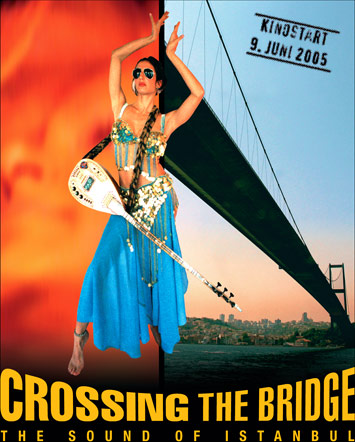

Crossing the Bridge
Deutschland 2004/2005, Dokumentary
Director Fatih Akin :Director of photography Hervé Dieu (also Asst. camera in Solino and Gegen die Wand);Editing Andrew Bird ;Sound Johannes Grehl ;Sound mixer Alexander Hacke ;Music Alexander Hacke ;Music (other) Klaus Maeck (Musik Consultant) ; Participation Alexander Hacke
Additional Titles Crossing the Bridge (Originaltitel, DE) ;Production company intervista digital media GmbH (Hamburg) (also produced Ayse Polat’s En Garde) in co-production with Corazón International (Hamburg) ;Producer Fatih Akin, Klaus Maeck, Andreas Thiel, Sandra Harzer-Kux, Jeanette Würl
Line producer Tina Mersmann ; Funding FilmFörderung Hamburg GmbH (Hamburg), Nordmedia Fonds GmbH
Istanbul Shoot: 01.07.04
Format DV - transfered to 35mm
Picture/Sound Color, Dolby
Author and Director: Fatih Akin
Length: 92 minFormat: 35 mm, color, aspect ratio 1:1,85Sound: DOLBY Digital EX 5.1
Year of Production: 2005
Release Date: 09.06.2005
Release Soundtrack: 06.06.2005
World Press Agent: RICHARD LORMANDworld cinema publicityCellphone +33 6 0949 7925Phone +33 1 4804 5173Fax +33 1 4804 8043www.filmpressplus.com
German Press: boxfish filmsBüro für Film + KommunikationKaren RudolphSenefelderstrasse 2210437 BerlinGermanyPhone +49 30 44 044 751Fax +49 30 44 044 691Email: rudolph@boxfish-films.dewww.boxfish-films.de
World sales: Bavaria Film International / Dept. of Bavaria Media GmbHThorsten RitterBavariafilmplatz 882031 GeiselgasteigGermanyPhone +49 / 89 / 64 99 26 86Fax +49 / 89 / 64 99 37 20Email: bavaria.international@bavaria-film.dewww.bavaria-film-international.de
GERMAN DISTRIBUTOR: PICTORION PICTURES GmbHAn der Hasenkaule 1-750354 HürthGermanywww.das-werk.deandNFP marketing & distribution*Henriette GotautKurfürstendamm 5710707 BerlinGermanyPhone +49 / 30 / 32 909 - 413Fax +49 / 30 / 32 909 - 419Email: H.Gotaut@NFP.dewww.nfp.de
Fatih Akin Nominated for David of Donatello
David of Donatello (the Italian Oscars) announced that Hamburg based German-Turkish film Director Fatih Akin was nominated for THE BEST EUROPEAN FILM with " LA SPOSA TURCA/ Head On" (BIM)
Subscribe to:
Posts (Atom)


 Posts
Posts

