
30 September 2005 05/86
bfi Distribution presents
FATE (Yazgi)
(Turkey 2001)
Written, directed and edited by Zeki Demirkubuz118 mins / colour / English subtitles / cert 15
Starring: Serdar Orcin, Zeynep Tokus, Engen Gunaydin, Demir Karahan
Release date: 3 February 2006
Opening venue: ICA, London
Fate, the brilliantly accomplished fourth feature of Turkish writer-director Zeki Demirkubuz, is an adaptation of Albert Camus' L’Etranger (The Outsider), transposed to present-day Istanbul.
Musa (based on Meursault, the anti-hero of Camus' novel) is a blank but wryly amused customs clerk who lives quietly with his elderly mother. He seeks no control over his own destiny but simply allows life to take its course. When, one day, he finds his mother dead at home, he shows no sign of emotion and maybe even experiences a sense of relief. But life, driven by fate, has some unexpected twists in store.
Born in Isparta in 1964, Demirkubuz was jailed for three years at the age of 17 for alleged communist ties. On release from prison he became a film-maker - more, he claims, by accident than by design. After working as an assistant director, he set up his own production company, Mavi Film, deliberately situating himself outside of Istanbul's mainstream Yesilcam Studios (Turkey's answer to Hollywood). Independent and uncompromising, Demirkubuz controls almost every aspect of his films, making few concessions to prevailing trends.
Written, directed and edited by Demirkubuz, Fate is austere cinema with a blackly comic edge. Beautifully controlled, with its restrained performances, long takes and sparing use of music (apart from two brief bursts of Mahler), it is a daring and deeply compelling enquiry into the nature of personal responsibility.
Together with the films of Nuri Bilge Ceylan (whose Uzak [Distant] was released last year to great acclaim), the work of Demirkubuz has sparked an international revival of interest in Turkish arthouse cinema. With two of his feature films, Fate and Confession, selected for the Un Certain Regard section of Cannes in 2002, Demirkubuz established himself as a talent to watch and was hailed as an important new auteur. His films were subsequently spotlighted at the Edinburgh, Vienna and Toronto Film Festivals, also receiving a complete retrospective at New York's Anthology Film Archives. With the release of Fate, bfi Distribution is proud to introduce a major new talent to UK audiences.
For further information please contact: Sarah Harvey on 020 7703 2253
or email press@sarahharvey.info or Elizabeth Benjamin at the bfi on 020 7849 4465 or email Elizabeth.Benjamin@bfi.org.uk
NOTES FOR EDITORS:
FILMOGRAPHY - ZEKI DEMIRKUBUZ
1994 Block C (C Blok)
1997 Innocence (Masumiyet)
1999 The Third Page (Ucuncu Sayfa)
2001 Fate (Yazgi)
2001 Confession (Itiraf)
2003 The Waiting Room (Bekleme Odasi)
The British Film Institute’s purpose is to champion moving image culture in all its richness and diversity across the UK, for the benefit of as wide an audience as possible, and to create and encourage debate. It does this by developing opportunities for all UK citizens to engage with film, TV and media heritage and culture. The bfi also works closely with national and regional partners to provide a focus for the diversity of UK moving image culture, while playing a key role in influencing the national and international agenda.
Established in 1933, the bfi provides a wide range of services, including: bfi National Film Theatre (NFT), bfi London IMAX Cinema (Britain’s largest screen), bfi National Library (the world’s leading specialist film & television library), bfi National Film & Television Archive (NFTVA, one of the world’s oldest and largest culturally significant film & TV archives), bfi London Film Festival, bfi London Lesbian & Gay Film Festival, bfi Distribution (making a wealth of world cinema available for theatrical screening across the UK), the renowned bfi DVD & Video catalogue of world and historic cinema, a wide range of award-winning bfi publications and bfi education materials, film footage, film stills, and research services for the commercial media industry, and the highly-respected Sight & Sound film magazine.
Tuesday, December 13, 2005


Friday, December 09, 2005
Eurimages Support for Turkey
Eurimages supports 13 European co-productions
STRASBOURG, 12.10.2005
At its 97th meeting held on 9.10.2005 - 11.10.2005 in Paris, the Council of Europe Eurimages Fund Board of Management agreed to support 13 feature films for a total amount of 3.89 Million Euros.
There is one Turkish co-production among the films that received support
Kader- Zeki Demirkubuz (Turkey, Greece)
Support was awarded to the following distributors:
SANARTFILM (Germany) for the distribution of the film
Yazi Tura (Heads or Tails)- Ugur Yucel (Turkish / turc)
BIR FILM ITHALAT (Turkey) for the distribution of the films
Manderlay- Lars Von Trier (Danish / danois)
Va, vis et deviens- Radu Mihaileanu (France)
CHANTIER FILMS (Turkey) for the distribution of the film
La Femme de Gilles- Frédéric Fonteyne (BE)
ERMAN FILM VE SINEMACILIK A.S. (Turkey) for the distribution of the film
L' Annulaire- Diane Bertrand (France)
SIR FILM ITHALAT VE PAZARLAMA (Turkey) for the distribution of the film
Dear Wendy- Thomas Vinterberg (Danish / danois)
Moreover, it has been decided to integrate retroactively from 1st January 2005 the six Turkish cinemas which applied for membership :
Atamerkez Safranbolu Sinemalari, Safranbolu
Cinebonus Konak, Izmir
Kadiköy Sinemalari, Kadiköy/Istanbul
Burc Altiparmak Bursa, Bursa
Diyarbakir Avrupa Sinemasi, Diyarbakir
Büyülüfener Kultur Merkezi, Ankara
STRASBOURG, 12.10.2005
At its 97th meeting held on 9.10.2005 - 11.10.2005 in Paris, the Council of Europe Eurimages Fund Board of Management agreed to support 13 feature films for a total amount of 3.89 Million Euros.
There is one Turkish co-production among the films that received support
Kader- Zeki Demirkubuz (Turkey, Greece)
Support was awarded to the following distributors:
SANARTFILM (Germany) for the distribution of the film
Yazi Tura (Heads or Tails)- Ugur Yucel (Turkish / turc)
BIR FILM ITHALAT (Turkey) for the distribution of the films
Manderlay- Lars Von Trier (Danish / danois)
Va, vis et deviens- Radu Mihaileanu (France)
CHANTIER FILMS (Turkey) for the distribution of the film
La Femme de Gilles- Frédéric Fonteyne (BE)
ERMAN FILM VE SINEMACILIK A.S. (Turkey) for the distribution of the film
L' Annulaire- Diane Bertrand (France)
SIR FILM ITHALAT VE PAZARLAMA (Turkey) for the distribution of the film
Dear Wendy- Thomas Vinterberg (Danish / danois)
Moreover, it has been decided to integrate retroactively from 1st January 2005 the six Turkish cinemas which applied for membership :
Atamerkez Safranbolu Sinemalari, Safranbolu
Cinebonus Konak, Izmir
Kadiköy Sinemalari, Kadiköy/Istanbul
Burc Altiparmak Bursa, Bursa
Diyarbakir Avrupa Sinemasi, Diyarbakir
Büyülüfener Kultur Merkezi, Ankara
Saturday, August 27, 2005
Emrah Yucel to Design Turkey’s Golden Orange Film Festival Posters

Published: Saturday, August 27, 2005
Source: zaman.com
Famous Turkish graphic designer, Emrah Yucel, who is known with his designs for Hollywood movies, will design the 42nd Antalya Golden Orange Film Festival poster, the First Eurasia International Film Festival posters and the Eurasia Film Fair posters that will be held in Turkey between September 24 and October 1.
The 42nd Golden Orange Film Festival, which is organized by Antalya Culture and Arts Foundation (AKSAV) and the Turk Audiovisual Culture Foundation (TURSAK), is becoming an international festival. Yucel noting he designs posters to contribute to the innovative studies by TURSAK’s Antalya Golden Orange Film Festival, said he would also be participating in the festival. Living in New York and Los Angeles since 1996, Yucel is a two time winner of the KeyArt award, the most important award in the sector in Los Angeles granted for 35 years. Yucel put his signature on several famous movie posters such as “Cold Mountain”, in which starred Nicole Kidman and Jude Law, in a Tarantino film “Kill Bill” with Uma Thurman, and one of the best Far Eastern films the “Hero”.Friday, July 29, 2005
Fratricide / Kardes Katili / Brudermord) (2004)
The World Premire of Fratricide will be as part of the competition in Locarno Film Festival 3-13 August 2005 | Turkish Cinema newsletter
Fratricide (Brudermord)
“I’m a f---ing moralist!” says Yilmaz Arslan.
It has been a long time since we last used the “m”-word, but in a world dominated by Hollywood, it’s good to remind us that there are still filmmakers out there who are driven by more than the desire to produce multi-part, merchandising-driven franchises.
Yilmaz Arslan, whose mother tongue is Arabic, was born in 1968 in Turkey and came to Germany with his parents when he was eight.
Fratricide, which uses the archaic form of tragedy to tell of the hatred, hardened by generations, between Turks and Kurds - an encounter with deadly consequences between two pairs of brothers in a foreign country - has its roots in a planned documentary. “I originally wanted to make a film about young Kurdish asylum seekers,” says Arslan, “but as the kids opened up and spoke to me I realized it was just too hot a topic. It would have gotten them into trouble. But it still boiled inside me and I decided to do it using fiction.”
Failing to get German subsidy money (“Ask them why!” says Arslan), he very quickly found Luxemburg and French partners. “There was instant understanding,” he says. “I got almost a declaration of love for the project.”
As for using non-actors, Arslan says “the film screams for them! I need fresh, young faces. They can’t look like they’re from Germany. The film has to be as authentic as possible; it has to look as authentic as possible. I’ve had good experience with amateurs and if you make an effort, give them a chance, they open up and develop.”
In examining why young people undertake the arduous and dangerous journey to Europe, Fratricide reveals “the almost magical attraction it holds for those fleeing war, or desperately seeking a better life. It’s a privilege to be a European,” says Arslan, “and it’s very important to sensitize these rich countries to the effect they have on others. It attracts them but they still remain spiritually crippled.”
“The world is already divided into a hierarchical structure,“ says Arslan. “The US, Europe, Asia, Africa. Tension leads to war and solving war is an economic factor. Children and young people are always the victims. They lose their lives and perspectives. Right now, there is a small war being waged against small, weak people right here in Europe. It’s meaningless and unfair.”
Yilmaz Arslan was born in Kazanli/Turkey in 1968 and came to West Germany in 1975. He founded the theater group "Summer-Winter" in 1988 and completed his secondary school education in 1991. His 1992 directorial debut, Passages, was named Best First Film at the San Sebastian and received a Silver Rose Prize in Bergamo and a nomination to the German Film Awards in 1993. His other films include Yara, which premiered at Venice in 1998, and Angst isst Seele auf (2002), which premiered at Venice in 2002.
Genre Drama
Category Feature Film Cinema
Year of Production 2004
Director Yilmaz Arslan
Screenplay Yilmaz Arslan
Director of Photography Juergen Juerges
Editor Peter Przygodda
Music by Rabih Abou-Khalil
Producers Yilmaz Arslan, Donato Rotunno, Eddy Géradon-Luyckx, Eric Tavitian, Horst Knechtel
Production Company Yilmaz Arslan Film/Mannheim, in co-production with Tarantula/Luxemburg, Tarantula/Paris, CineImages/Martinsried
Format 35 mm, color, 1:1.85
Shooting Language German/Turkish/Kurdisch
Shooting in France, Luxemburg, Kurdistan, June - August 2004
Sound Technology Dolby SR
Festival Screenings Locarno 2005
With backing from MFG Baden-Wuerttemberg, Hessische Rundfunk Foerderung, MEDIA, Rhone Alpes Cinema, Film Fonds Luxemburg
Contact
Yilmaz Arslan Filmproduktion GmbH
Yilmaz Arslan, Petra Barkowski-Arslan
J6, 1
68159 Mannheim/Germany
phone +49-6 21-1 58 29 38
fax +49-6 21-1 56 93 66
email: arslan-film@web.de
Fratricide (Brudermord)

Yilmaz Arslan
“I’m a f---ing moralist!” says Yilmaz Arslan.
It has been a long time since we last used the “m”-word, but in a world dominated by Hollywood, it’s good to remind us that there are still filmmakers out there who are driven by more than the desire to produce multi-part, merchandising-driven franchises.
Yilmaz Arslan, whose mother tongue is Arabic, was born in 1968 in Turkey and came to Germany with his parents when he was eight.
Fratricide, which uses the archaic form of tragedy to tell of the hatred, hardened by generations, between Turks and Kurds - an encounter with deadly consequences between two pairs of brothers in a foreign country - has its roots in a planned documentary. “I originally wanted to make a film about young Kurdish asylum seekers,” says Arslan, “but as the kids opened up and spoke to me I realized it was just too hot a topic. It would have gotten them into trouble. But it still boiled inside me and I decided to do it using fiction.”
Failing to get German subsidy money (“Ask them why!” says Arslan), he very quickly found Luxemburg and French partners. “There was instant understanding,” he says. “I got almost a declaration of love for the project.”
As for using non-actors, Arslan says “the film screams for them! I need fresh, young faces. They can’t look like they’re from Germany. The film has to be as authentic as possible; it has to look as authentic as possible. I’ve had good experience with amateurs and if you make an effort, give them a chance, they open up and develop.”
In examining why young people undertake the arduous and dangerous journey to Europe, Fratricide reveals “the almost magical attraction it holds for those fleeing war, or desperately seeking a better life. It’s a privilege to be a European,” says Arslan, “and it’s very important to sensitize these rich countries to the effect they have on others. It attracts them but they still remain spiritually crippled.”
“The world is already divided into a hierarchical structure,“ says Arslan. “The US, Europe, Asia, Africa. Tension leads to war and solving war is an economic factor. Children and young people are always the victims. They lose their lives and perspectives. Right now, there is a small war being waged against small, weak people right here in Europe. It’s meaningless and unfair.”
Yilmaz Arslan was born in Kazanli/Turkey in 1968 and came to West Germany in 1975. He founded the theater group "Summer-Winter" in 1988 and completed his secondary school education in 1991. His 1992 directorial debut, Passages, was named Best First Film at the San Sebastian and received a Silver Rose Prize in Bergamo and a nomination to the German Film Awards in 1993. His other films include Yara, which premiered at Venice in 1998, and Angst isst Seele auf (2002), which premiered at Venice in 2002.
Genre Drama
Category Feature Film Cinema
Year of Production 2004
Director Yilmaz Arslan
Screenplay Yilmaz Arslan
Director of Photography Juergen Juerges
Editor Peter Przygodda
Music by Rabih Abou-Khalil
Producers Yilmaz Arslan, Donato Rotunno, Eddy Géradon-Luyckx, Eric Tavitian, Horst Knechtel
Production Company Yilmaz Arslan Film/Mannheim, in co-production with Tarantula/Luxemburg, Tarantula/Paris, CineImages/Martinsried
Format 35 mm, color, 1:1.85
Shooting Language German/Turkish/Kurdisch
Shooting in France, Luxemburg, Kurdistan, June - August 2004
Sound Technology Dolby SR
Festival Screenings Locarno 2005
With backing from MFG Baden-Wuerttemberg, Hessische Rundfunk Foerderung, MEDIA, Rhone Alpes Cinema, Film Fonds Luxemburg
Contact
Yilmaz Arslan Filmproduktion GmbH
Yilmaz Arslan, Petra Barkowski-Arslan
J6, 1
68159 Mannheim/Germany
phone +49-6 21-1 58 29 38
fax +49-6 21-1 56 93 66
email: arslan-film@web.de
Friday, July 08, 2005
Thursday, July 07, 2005
BOATS OUT OF WATERMELON RINDS (2004)

BOATS OUT OF WATERMELON RINDS (Karpuz Kabugundan Gemiler Yapmak)
Turkey 2004 Directed and Screenplay by: Ahmet Uluçay
Cinematography by: Ilker Berke
Edited by: Mustafa Presheva, Senad Presheva
Sound: Bülent Nurgonul
Music by: Ender Akay, Alper Tunga Demirel
Costume Dewsign by: Kostüm Pinar Kesen, Fatos Acar
Cast:Ismail Hakki Taslak (Recep), Kadir Kaymaz (Mehmet)
Production: IFR A.S Altzeren Sok. No:1 Levent Istanbul, Türkey Tel: 212 3247624 film@ifr.com.tr
Distribution: Silkroad Productions 8 rue Myrha 75018 Paris, France T 1 53 41 4161 bh@silkroadproduction.com
35 mm/1:1,85/Colour 97 minutes
Director's remarks: Ahmet Ulucay was born in Tepecik, a village near Tavsanli, where he has always lived. Over the last 15 years he made successful short films, including: Optical Dreams (1994), Pearl is Under the Water (1996), Epileptic Film (1998, Award for Best Film at the International Film Festival in Ankara), Exorcise (2000). Karpuz kabugundan gemiler yapmak (Boats Out of Watermelon Rinds) is his first feature film.
Synopsis: An autobiographical first feature film from Ahmet Ulucay who still lives in the village of Tepecik, where he was born. It's the 60s and Recep and Mehmet are two boys crazy about movies. After work, they spend their evenings building a film projector, witnessed only by Crazy Omer, the village idiot. But things begin to change when Recep falls for Nihal, the eldest daughter of the widow Nezihe. His feelings are not reciprocated, whereas Nihal's younger sister, Guler, is interested in Recep who is definitely not interested in her...Synopsis 2: The film, which is about two village boys who passionately love movies, has its roots in the writer/director Ahmet Ulucay's own childhood. The story takes place during one summer season in the late sixties. The location is the town of Tavsanli and the village of Tepecik. The boys work and go through romantic experiences in town during the daytime, and dream about cinema in their village at nights. The cast is comprised entirely of the local people of Tavsanli, the site of almost all the locations in the film. The format used for shooting is miniDV which was transferred to 35mm after post-production.
Film Notes: Boats out of Watermelon Rinds unfurls the story of Recep and Mehmet, two young friends of modest means and admirable ambitions. It is only thanks to their evening exploits that the boys can endure their apprenticeships with, respectively, a watermelon vendor and a domineering barber. After discovering that the small local theater regularly discards worn-out film, the boys have begun collecting and, in their own strange fashion (think wooden-box-and-a-lightbulb), screening these cinematic cast-offs each night in an abandoned shed. They lack a projector, barely understand the mechanical processes involved and have only the village fool, crazy Ömer, as an audience. Nonetheless, they are undaunted. Shot entirely on digital video and blown up to 35mm, Boats out of Watermelon Rinds is lushly painted with inspired plays of colour and a keen eye for landscape; it conjures up a time and place far away, but somehow completely familiar. This is an infatuating, prodigious debut and a stirring tribute to a lifelong love of the cinema. (Dimitri Eipides)

LOVELORN / GONUL YARASI (2005)


GONUL YARASI
Directed by: Yavuz Turgul
Cast: Sener Sen, Metlem Cumbul, Timucin Esen, Guven Kirac, Devin Ozgun. 2 hours 23 mins
Idealist elementary school teacher Nazim (named after the great communist poet Nazim Hikmet) retires and returns home to Istanbul, after a 15 year term in the poor, forgotten Kurdish-Alevite village in Eastern Turkey. Politely ignored by his children who secretly despise him since he chose his ideal over his family long ago, he begins a new (night) life as a taxi driver.
There he meets a fallen single mother who works as a "singer" in a sleazy night club. He takes the mother and her daugther in to protect them from the stalker ex-husband, falls in love with her, and the drama unfolds.
BBC Review:
Lovelorn (Gonul Yarasi) A minicab driver gets more than he bargained for when he helps a nightclub singer in this Turkish drama.
A minor Turkish melodrama that's easy on the eye but not the watch, Gonul Yarasi follows ageing minicab driver Nazim (Sener Sen), who picks up more than just another passenger when he befriends nightclub singer Dunya (Meltem Cumbul). His grown-up kids think he's lost his marbles, but Nazim wants to help the beautiful young woman and her daughter escape her abusive ex-husband. Things aren't that simple, though, as Gonul Yarasi tries to live up to its melancholy.
"The woman is a rascal and the man is a lunatic - don't get caught in between," warns Nazim's greying pal Atakan (Sumer Tilmac) an old-time cabbie with plenty of experience on the clock. He's not the only one who's worried: Nazim's kids think the singer's a gold-digging floozy who's after their inheritance, while Dunya's violent ex-hubby (Timucin Esen) just wants to get custody of their traumatised - and now mute - daughter.
"A LIGHTWEIGHT TALE"
Wife beating, rape and child abduction may sound awfully serious, but nothing's ever that terrible - or threatening - in this lightweight tale. Lathering the more threatening moments in soapsuds, G Yarasi works best when playing up the comedy. Cantankerous old Atakan steals the show as a bellowing ex-heavy grown fat and old, leaving gifted Turkish actor Sener Sen to look as unconvinced by the tart-with-a-heart storyline as the rest of us. A confrontation over the family's inheritance and an undeveloped political subtext threaten to turn the movie sour yet, apart from a few mournful nightclub ballads, the lovelorn tears seem insincere.
In Turkish with English subtitles.
Andrew Pulver
Friday January 28, 2005
The Guardian
As discussions continue over its social and political direction, Turkey is indulging in some serious cultural self-promotion in this country - presumably to lay the groundwork for future EU integration. The mammoth Turks exhibition at the Royal Academy in London is the main weapon, but Turkish cinema is doing its bit too.
Nuri Bilge Ceylan's Distant proved an art-cinema success last year, but the commercial end of the country's cinema is making a determined effort to cross over here as well - a considerably more difficult undertaking. A few weeks ago saw the UK release of Turkey's biggest-ever homegrown hit GORA - an expensively mounted but unrelentingly witless mishmash of sci-fi cliches - and here's another: an earnest, heartfelt family drama that, despite its two-hours-plus length, manages to remain reasonably watchable.
Lovelorn's central figure is Nazim (Sener Sen), a retired teacher returning to Istanbul after a lifetime of teaching in Kurdish primary schools. He's a member of the fiercely patriotic yet secular liberal generation whose values are increasingly under siege from Turkey's version of yuppiedom - represented here by his resentful children, Mehmet and Piraye. (They want him to sell his property and give them the money, but he can't face kicking out the poor family who rent it from him.)
Bored and lonely, Nazim takes to cab-driving, and finds a new focus for his affections on troubled single mother Dunya: a bar balladeer being stalked by her violent husband.
No prizes for guessing where the story goes, or for sitting through the "you were never there for me" scenes between Nazim and his kids - thereby proving that you don't have to come from Hollywood to whip up a frenzy of saccharine-tainted emotions. But Turgul's straightforward storytelling keeps things moving, and Sen is a quietly engaging performer at the heart of the matter.
Friday, June 17, 2005
Review | Crossing the Bridge
Crossing the Bridge -- The Sound of Istanbul
By Duane Byrge
Bottom line: Hip-hop trips on Arabesque in this cross-cultural musical mix but that old-fashioned Kurdish lament soars.
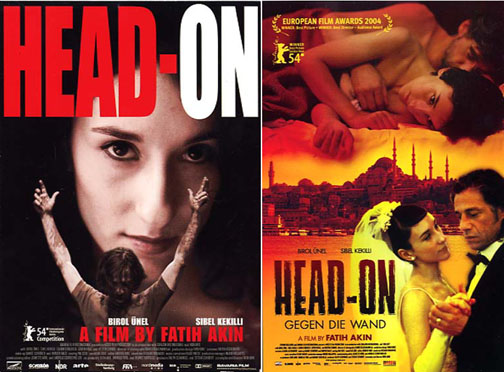
East is East and West is West, and never the twain shall meet is the refuted refrain of this musical exploration, namely the symbiosis of musical sounds in Istanbul, from eastern Anatolian to Western hip-hop.Scripted and directed by Fatih Akin ("Head-On"), this musical documentary likely will find its major audience in Germany, where the immigrant-minority Turk citizenry will take to its array of sounds, smears and social commentary as cultural nourishment.
Filmmaker Akin centers his musical exploration "Crossing the Bridge" around Alexander Hacke, a member of the German avant-garde group Einsturzende Neubauten. Ensconcing himself in Istanbul's Grand Hotel de Londres with a computer, Hacke embarks on recording the musical diversity of Istanbul, the Turkish city that is thought of as bridging the East and the West. Quite sagely, but almost disastrously, Hacke's musicological trip begins with a neo-psychedelic band, Baba Zula, whose influences run from Pink Floyd to Oriental strains. Unfortunately, the Baba Zula wawa is faux: It's a noxious mix of "flower power" with Arabian Nights kitsch -- marginally appealing to Europeans and anathema to Turks.
It's the worst kind of jam session, namely jamming together the asynchronous sounds of two vastly different traditions to create, well, an atonal mess. It's not until nearly the midpoint of this comprehensive film that "Bridge" finds its thematic voice and, ironically, when it contradicts itself with an emphasis on the musical purities of the separate traditions. Only when the multicultural conceit of vastly different musical traditions blending to produce a transcendent sound is muted does the film finally jell.
A musical high point, and the moment when the nonsensical notion of eliminating all differences within a multiethnic society is neatly decimated, is the rousing performance of Kurdish singer Aynur. Her glorious vocal lamentations of her oppressed people reverberates with a proud melancholy -- much richer and far more glorious than the forced mix of the modern musical movements.
Crossing the Bridge Bavaria Film International Producers: Fatih Akin, Klaus Maeck, Andreas Thiel, Sandra Harzer-Kux, Christian Kux Screenwriter-director: Fatih Akin Line producer: Tina Mersmann Director of photography: Herve Dieu Editor: Andrew Bird Sound: Johannes Grehl: Music and sound: Alexander Hacke Music Consultant: Klaus Maeck Cast: Alexander Hacke, Baba Zula, Orient Expressions, Duman, Replikas, Erkin Koray, Ceza,Sezen Aksu, Orhan Gencebay Running time -- 90 minutes
By Duane Byrge
Bottom line: Hip-hop trips on Arabesque in this cross-cultural musical mix but that old-fashioned Kurdish lament soars.
East is East and West is West, and never the twain shall meet is the refuted refrain of this musical exploration, namely the symbiosis of musical sounds in Istanbul, from eastern Anatolian to Western hip-hop.Scripted and directed by Fatih Akin ("Head-On"), this musical documentary likely will find its major audience in Germany, where the immigrant-minority Turk citizenry will take to its array of sounds, smears and social commentary as cultural nourishment.
Filmmaker Akin centers his musical exploration "Crossing the Bridge" around Alexander Hacke, a member of the German avant-garde group Einsturzende Neubauten. Ensconcing himself in Istanbul's Grand Hotel de Londres with a computer, Hacke embarks on recording the musical diversity of Istanbul, the Turkish city that is thought of as bridging the East and the West. Quite sagely, but almost disastrously, Hacke's musicological trip begins with a neo-psychedelic band, Baba Zula, whose influences run from Pink Floyd to Oriental strains. Unfortunately, the Baba Zula wawa is faux: It's a noxious mix of "flower power" with Arabian Nights kitsch -- marginally appealing to Europeans and anathema to Turks.
It's the worst kind of jam session, namely jamming together the asynchronous sounds of two vastly different traditions to create, well, an atonal mess. It's not until nearly the midpoint of this comprehensive film that "Bridge" finds its thematic voice and, ironically, when it contradicts itself with an emphasis on the musical purities of the separate traditions. Only when the multicultural conceit of vastly different musical traditions blending to produce a transcendent sound is muted does the film finally jell.
A musical high point, and the moment when the nonsensical notion of eliminating all differences within a multiethnic society is neatly decimated, is the rousing performance of Kurdish singer Aynur. Her glorious vocal lamentations of her oppressed people reverberates with a proud melancholy -- much richer and far more glorious than the forced mix of the modern musical movements.
Crossing the Bridge Bavaria Film International Producers: Fatih Akin, Klaus Maeck, Andreas Thiel, Sandra Harzer-Kux, Christian Kux Screenwriter-director: Fatih Akin Line producer: Tina Mersmann Director of photography: Herve Dieu Editor: Andrew Bird Sound: Johannes Grehl: Music and sound: Alexander Hacke Music Consultant: Klaus Maeck Cast: Alexander Hacke, Baba Zula, Orient Expressions, Duman, Replikas, Erkin Koray, Ceza,Sezen Aksu, Orhan Gencebay Running time -- 90 minutes
Friday, May 27, 2005


Tuesday, May 24, 2005
8TH ''FLYING BROOM'' INTERNATIONAL WOMEN'S FILM FESTIVAL
The 8th Flying Broom International Women's Film Festival was held from May 5-15. The theme of this year's festival was ''Love''. A total of 93 films from 21 countries were shown during the festival. The well-known Turkish actress, Sevda Ferdağ, was presented the ''Flying Broom Honorary Award'' at the festival.
The Festival began in Ankara with a ceremony at the State Opera and Ballet Center.
Halime Güner, General Coordinator of Flying Broom, stated that the festival included conferences on issues pertaining to women.
Russia was the guest of the ''One Country'' category in the festival. ''Babusya'' by Lidiya Bobrova, ''Harvest Time'' by Marina Razbezhkina and ''Shizo'' by Marina Razbezhkina were shown. The films of the world-famous female director Agnieszka Holland such as ''Europa Europa'', ''Olivier, Olivier'', ''Total Eclipse'' and ''Julie Walking Home'' were also screened. Indian director Deepa Mehta was also the guest at this year's festival with her films. The viewers had the opportunity to view the films starring Greta Garbo, who has been qualified as being one of the outstanding female actresses in the history of the cinema ''Anna Karenina'', ''Grand Hotel'' and ''Ninotchka'' starring Grate Garbo were shown at the Festival. Semiha Berksoy, the first lady of Turkish opera as well as one of the most colorful figures in contemporary Turkish art, who died last year of a pulmonary embolism, at the age of 94, was commemorated in the festival with her film ''The Serpent's Tale''. For the first time in the festival, there was a special category for male directors: ''Men in Love''.
The program included some 90 films from all over the world. Some of the categories were:
- Each has a different color - Greta Garbo
- Our cinema - Agnieszka Holland
- One country: Russia - Men in Love
- Short films - Documentaries
- Beyond pink and blue - Animations
There was a panel discussion during the festival on women in the movie industry.
On the opening and closing nights of the festival, Flying Broom distributed the Bilge Olgaç Achievement Awards and the Flying Broom Honorary Award.
FIPRESCI: Flying Broom is the only women's film festival where there is an official jury from the International Federation of Film Critics. This year, for the third time, the prestigious FIPRESCI Prize went to one of the fourteen new features in the category 'Each has a Different Color'.
Who was the angel, and what happened to her?
The annual screenplay contest aims to encourage people to express their thoughts and experiences in the language of film. And apparently it’s getting popular: This year, the Flying Broom received close to 300 screenplays from hopeful competitors around the world. Ten writers have been invited to join a workshop headed by famous Turkish scriptwriter and director Işıl Özgentürk. All scenarios written at the workshop will eventually be compiled into a book by Flying Broom, and the winning manuscript will be filmed by Filma-Cass and shown at next year’s Festival.
The competition has no limitations regarding subject or genre. Contributors have been given an interesting clue to work with: ‘Your mother was an angel, my baby’. This is a phrase often heard in the mainstream of Turkish films during the 60s and 70s, and Flying Broom suggested that contributors to think about motherhood and the stories related to: “Who was the angel, and what happened to her?”
The Festival began in Ankara with a ceremony at the State Opera and Ballet Center.
Halime Güner, General Coordinator of Flying Broom, stated that the festival included conferences on issues pertaining to women.
Russia was the guest of the ''One Country'' category in the festival. ''Babusya'' by Lidiya Bobrova, ''Harvest Time'' by Marina Razbezhkina and ''Shizo'' by Marina Razbezhkina were shown. The films of the world-famous female director Agnieszka Holland such as ''Europa Europa'', ''Olivier, Olivier'', ''Total Eclipse'' and ''Julie Walking Home'' were also screened. Indian director Deepa Mehta was also the guest at this year's festival with her films. The viewers had the opportunity to view the films starring Greta Garbo, who has been qualified as being one of the outstanding female actresses in the history of the cinema ''Anna Karenina'', ''Grand Hotel'' and ''Ninotchka'' starring Grate Garbo were shown at the Festival. Semiha Berksoy, the first lady of Turkish opera as well as one of the most colorful figures in contemporary Turkish art, who died last year of a pulmonary embolism, at the age of 94, was commemorated in the festival with her film ''The Serpent's Tale''. For the first time in the festival, there was a special category for male directors: ''Men in Love''.
The program included some 90 films from all over the world. Some of the categories were:
- Each has a different color - Greta Garbo
- Our cinema - Agnieszka Holland
- One country: Russia - Men in Love
- Short films - Documentaries
- Beyond pink and blue - Animations
There was a panel discussion during the festival on women in the movie industry.
On the opening and closing nights of the festival, Flying Broom distributed the Bilge Olgaç Achievement Awards and the Flying Broom Honorary Award.
FIPRESCI: Flying Broom is the only women's film festival where there is an official jury from the International Federation of Film Critics. This year, for the third time, the prestigious FIPRESCI Prize went to one of the fourteen new features in the category 'Each has a Different Color'.
Who was the angel, and what happened to her?
The annual screenplay contest aims to encourage people to express their thoughts and experiences in the language of film. And apparently it’s getting popular: This year, the Flying Broom received close to 300 screenplays from hopeful competitors around the world. Ten writers have been invited to join a workshop headed by famous Turkish scriptwriter and director Işıl Özgentürk. All scenarios written at the workshop will eventually be compiled into a book by Flying Broom, and the winning manuscript will be filmed by Filma-Cass and shown at next year’s Festival.
The competition has no limitations regarding subject or genre. Contributors have been given an interesting clue to work with: ‘Your mother was an angel, my baby’. This is a phrase often heard in the mainstream of Turkish films during the 60s and 70s, and Flying Broom suggested that contributors to think about motherhood and the stories related to: “Who was the angel, and what happened to her?”
Sunday, May 15, 2005
Kilometre Zero (2005)
Kilometre Zero
By Duane Byrge
Bottom line: A blunt but often powerful glimpse into the horrors of Saddam Hussein's Iraq and the ethnic strife between Arabs and Kurds.
It's a road picture with a MacGuffin. Yet in this powerful, contemporary case, it's no standard generic product: The road is the dusty backways of Iraq, and the MacGuffin is a dead Iraqi soldier whom our battling, nonbuddy heroes must transport to his family. Although generically structured, "Kilometre Zero" offers a searing look into the horrors the people of Iraq, specifically the Kurds, suffered under the brutish tyranny of Saddam Hussein.
Its most hospitable U.S. venue might be 1600 Pennsylvania Ave., since this Competition entrant personalizes the freedom one Kurdish family attains as a result of the U.S. liberation of Iraq and the downfall of Hussein. Unfortunately, "Kilometre's" powerful message is delivered with often blunt aesthetics, and commercial prospects are negligible unless the Republican Party gets into the film distribution racket.
Set in 1988 amid the Iraq-Iran war, we follow a young Kurdish husband and father, Ako (Nazmi Kirik), as he is conscripted into the Iraqi Army and thrust into the front lines. Army life is brutal and hellish, and the real enemies, it seems, are his sadistic superior officers. With awful equipment, no training and boneheaded strategy, the "grand army" bungles along on its belly, generally entrenched under enemy bombardment. However, the god of the military bureaucracy shines on Ako when he is assigned to accompany a fellow soldier's corpse to his family and temporarily leave the mayhem. With a flag-wrapped coffin atop an orange GMC vehicle, Ako and an Iraqi cab driver (Robert Alazraki) set out on their mission.
Ako and the driver exchange hostile words: The hatred between the Arab and the Kurd is emblematic of the ethnic strife in that tyrannized land. Unfortunately, writer-director Hiner Saleem's filmmaking skills are not always sufficient for his theme and story. The dialogue is often expositional and the visuals somewhat crude. The epiphany these men finally reach is muddled by Saleem's uneven storytelling. Eventually, it jumps forward to the present and a maudlin last shot of Ako and his family gazing at the Eiffel Tower, representing freedom -- a bit cheeky, one might add, given France's opposition to the conflict in Iraq.
In certain instances, the film resembles a rough cut, but there is a diamond of a story beneath its modest budget constraints. A cortege of coffin-bearing cabs as they wind across the horizon is a searing correlative for the sad horrors of life in Iraq. A sobering, running gag is a towering statue of Saddam Hussein on a flatbed truck that seems to shadow our travelers' transport. There is also some contrapuntal comedic hilarity as the bombastic military music of the Iraqi Army blasts from the cab radio.
Under Saleem's hand, the technical contributions are frequently eloquent, specifically composer Nikos Kipourgos' baleful score, amplified with the wails of a sad people's plea.
KILOMETRE ZERO
Memento Films Distribution
Memento Films Production/La Cinefacture, Hiner Saleem Prods.
Credits:
Screenwriter-director: Hiner Saleem
Director of photography: Robert Alazraki
Production designer: Kamal Hamarash
Music: Nikos Kipourgos
Editor: Anna Ruiz
Sound: Freddy Loth
Cast:
Ako: Nazmi Kirik
Salma: Belcim Bigin
Taxi driver: Robert Alazraki
No MPAA rating
Running time -- 91 minutes

Actress Belcim Bilgin and actor Nazmi Kirik pose during a photocall for Iraqi-born director Hiner Saleem's film 'Kilometre Zero' at the 58th Cannes Film Festival, May 12, 2005. Photo by Vincent Kessler/Reuters
By Duane Byrge
Bottom line: A blunt but often powerful glimpse into the horrors of Saddam Hussein's Iraq and the ethnic strife between Arabs and Kurds.
It's a road picture with a MacGuffin. Yet in this powerful, contemporary case, it's no standard generic product: The road is the dusty backways of Iraq, and the MacGuffin is a dead Iraqi soldier whom our battling, nonbuddy heroes must transport to his family. Although generically structured, "Kilometre Zero" offers a searing look into the horrors the people of Iraq, specifically the Kurds, suffered under the brutish tyranny of Saddam Hussein.
Its most hospitable U.S. venue might be 1600 Pennsylvania Ave., since this Competition entrant personalizes the freedom one Kurdish family attains as a result of the U.S. liberation of Iraq and the downfall of Hussein. Unfortunately, "Kilometre's" powerful message is delivered with often blunt aesthetics, and commercial prospects are negligible unless the Republican Party gets into the film distribution racket.
Set in 1988 amid the Iraq-Iran war, we follow a young Kurdish husband and father, Ako (Nazmi Kirik), as he is conscripted into the Iraqi Army and thrust into the front lines. Army life is brutal and hellish, and the real enemies, it seems, are his sadistic superior officers. With awful equipment, no training and boneheaded strategy, the "grand army" bungles along on its belly, generally entrenched under enemy bombardment. However, the god of the military bureaucracy shines on Ako when he is assigned to accompany a fellow soldier's corpse to his family and temporarily leave the mayhem. With a flag-wrapped coffin atop an orange GMC vehicle, Ako and an Iraqi cab driver (Robert Alazraki) set out on their mission.
Ako and the driver exchange hostile words: The hatred between the Arab and the Kurd is emblematic of the ethnic strife in that tyrannized land. Unfortunately, writer-director Hiner Saleem's filmmaking skills are not always sufficient for his theme and story. The dialogue is often expositional and the visuals somewhat crude. The epiphany these men finally reach is muddled by Saleem's uneven storytelling. Eventually, it jumps forward to the present and a maudlin last shot of Ako and his family gazing at the Eiffel Tower, representing freedom -- a bit cheeky, one might add, given France's opposition to the conflict in Iraq.
In certain instances, the film resembles a rough cut, but there is a diamond of a story beneath its modest budget constraints. A cortege of coffin-bearing cabs as they wind across the horizon is a searing correlative for the sad horrors of life in Iraq. A sobering, running gag is a towering statue of Saddam Hussein on a flatbed truck that seems to shadow our travelers' transport. There is also some contrapuntal comedic hilarity as the bombastic military music of the Iraqi Army blasts from the cab radio.
Under Saleem's hand, the technical contributions are frequently eloquent, specifically composer Nikos Kipourgos' baleful score, amplified with the wails of a sad people's plea.
KILOMETRE ZERO
Memento Films Distribution
Memento Films Production/La Cinefacture, Hiner Saleem Prods.
Credits:
Screenwriter-director: Hiner Saleem
Director of photography: Robert Alazraki
Production designer: Kamal Hamarash
Music: Nikos Kipourgos
Editor: Anna Ruiz
Sound: Freddy Loth
Cast:
Ako: Nazmi Kirik
Salma: Belcim Bigin
Taxi driver: Robert Alazraki
No MPAA rating
Running time -- 91 minutes
Saturday, May 14, 2005
Yatik Emine / Emine (1974)
Yatik Emine / Emine / Emine la brûlée
1974 90 color 90 min.
Directed by:Ömer Kavur ; Written by:Ömer Kavur, Turgut Ozakman based on a novel by Refik Halit karay; Cinematography
by:Renato Fait; Edited by:Ömer Kavur,Renato Fait; Music by: Arif Erkin; Sound by: Feridun Kinay; Produced by: Duran Tantekin. Cast: Necla Nazir, Serdar Gokhan, Mahmut Hekimoglu, Bilal Inci, Atilla Ergun, Osman Alyanak, Guzin Ozipek,
Renan Fosforoglu.
Synopsis: "Yatik Emine" tells the story of a prostitute in exile during the First World War. In 1990 a prostitute called Yatik Emine is sent on exile to a small Anatolian town. Not knowing how to deal with the problem, the young lieutenant in
charge has her placed temporarily in prison. However her arrival causses great dissatisfaction amongst the native people.
As a result the town's cauncil takes this complaint to the governor. But in prison Emine is badly beaten by a prisoner sentenced for having killed her husband. The governor finds a solution for Emine by lodging her with her janitor.Emine is happy in the janitor'shouse and she gets along well with his wife. Native women who want to see Emine satisfy their curiousty by coming to visit the janitor's wife. Whenone day the janitor takes advantage of his wife's absence and tries to rape Emine they are discovered on the act and Emine is savagely beaten. Emine is carried to the hospital.
Here she meets a political exile working as an attendant, his name is Server. Server showsher sympathy and they soon become close friends. However when this friendship is a subject to discussion by the doctoramongst the officials, the lieutenant jealous has her moved to an isolated house in the outskirts of the town. Emine in search for work is rejected at each attempt, finally she decides to take a petition to the officials for a job. She meets a mad petition writer who helps her gratuitously. The lieutenant having read the petition grants her a daily loaf of bread. Server also doesn't loose track of her andcontinues to offer this help. He furnishes her home, takes her food and after a while they begin living together. This provokes new reactions amongst the natives, Riza the town's tough guy making this a question of honor starts a fight with Server. Server beats Riza but is sent fron the town to a stone mine by the authorities.
The lieutenant who is conditioned by his official situation is conscious that he no longer can help Emine and decides to leave for an inspection. Emine is left all alone to her fate. Riza seizes this opportunity to take a friend to Emine to cure him of his impotence...
1974 90 color 90 min.
Directed by:Ömer Kavur ; Written by:Ömer Kavur, Turgut Ozakman based on a novel by Refik Halit karay; Cinematography
by:Renato Fait; Edited by:Ömer Kavur,Renato Fait; Music by: Arif Erkin; Sound by: Feridun Kinay; Produced by: Duran Tantekin. Cast: Necla Nazir, Serdar Gokhan, Mahmut Hekimoglu, Bilal Inci, Atilla Ergun, Osman Alyanak, Guzin Ozipek,
Renan Fosforoglu.
Synopsis: "Yatik Emine" tells the story of a prostitute in exile during the First World War. In 1990 a prostitute called Yatik Emine is sent on exile to a small Anatolian town. Not knowing how to deal with the problem, the young lieutenant in
charge has her placed temporarily in prison. However her arrival causses great dissatisfaction amongst the native people.
As a result the town's cauncil takes this complaint to the governor. But in prison Emine is badly beaten by a prisoner sentenced for having killed her husband. The governor finds a solution for Emine by lodging her with her janitor.Emine is happy in the janitor'shouse and she gets along well with his wife. Native women who want to see Emine satisfy their curiousty by coming to visit the janitor's wife. Whenone day the janitor takes advantage of his wife's absence and tries to rape Emine they are discovered on the act and Emine is savagely beaten. Emine is carried to the hospital.
Here she meets a political exile working as an attendant, his name is Server. Server showsher sympathy and they soon become close friends. However when this friendship is a subject to discussion by the doctoramongst the officials, the lieutenant jealous has her moved to an isolated house in the outskirts of the town. Emine in search for work is rejected at each attempt, finally she decides to take a petition to the officials for a job. She meets a mad petition writer who helps her gratuitously. The lieutenant having read the petition grants her a daily loaf of bread. Server also doesn't loose track of her andcontinues to offer this help. He furnishes her home, takes her food and after a while they begin living together. This provokes new reactions amongst the natives, Riza the town's tough guy making this a question of honor starts a fight with Server. Server beats Riza but is sent fron the town to a stone mine by the authorities.
The lieutenant who is conditioned by his official situation is conscious that he no longer can help Emine and decides to leave for an inspection. Emine is left all alone to her fate. Riza seizes this opportunity to take a friend to Emine to cure him of his impotence...
CROSSING THE BRIDGE - THE SOUND OF ISTANBUL
CROSSING THE BRIDGE - THE SOUND OF ISTANBUL (THE SOUND OF ISTANBUL)
directed by Fatih AKIN
GERMANYThe German-born Turkish director Fatih Akin, a member of the jury for the Festival's Official Selection of feature films, has also made the journey to the Croisette this year to present his new film, Crossing the Bridge, out of competition. Five years after making Wir haben vergessen zurückzukehren, the filmmaker, who was awarded a Berlin Festival Golden Bear in 2004 for Head-On, revisits the documentary genre to portray the daily life, rich with musical and cultural wealth, of the inhabitants of Istanbul, the great metropolis located at the crossroads between Orient and Occident.
One of the main personalities you'll meet on screen in this narrative is musician and composer Alexander Hacke. A veteran of the German avant-garde music scene, he arrives in Istanbul to write the sound track for the film Head-On. His meeting with the members of the neo-psychedelic band Baba Zula is decisive. With their guidance, he succeeds in assembling a collage of Istanbul's musical diversity, a colorful patchwork of sounds and moods for the whole world to appreciate. One of Fatih Akin's main purposes in this documentary is to make international audiences aware of the originality of Istanbul's forms of musical expression, both modern and ancient.
1.) Confucius says:
When you come to a place and want to understand it, listen to the music that is played there.
2.) I don't believe the East starts in Istanbul and goes to China. And the West starts in Greece and goes to L.A.
Orient Expressions
3.) Music is only one of the toys that can change the world. The street is neutral turf. That's why it brings people together. Whatever class you belong to, it's a common denominator for everyone.
Siyasiyabend
This documentary is about musical, cultural and every-day life in the Turkish metropolis between orient and occident. With his film the author and director Fatih Akin wishes to introduce an international audience to the diversity and uniqueness of the historic and recent espressions of musical creativity in the heart of Istanbul.
Mercan DEDE
ORIENT EXPRESSIONS
DUMAN
REPLIKAS
Erkin KORAY
CEZA
ISTANBUL STYLE BREAKERS
Alexander HACKE
Baba ZULA
SEZEN AKSU
Orhan GENCEBAY
directed by Fatih AKIN
GERMANYThe German-born Turkish director Fatih Akin, a member of the jury for the Festival's Official Selection of feature films, has also made the journey to the Croisette this year to present his new film, Crossing the Bridge, out of competition. Five years after making Wir haben vergessen zurückzukehren, the filmmaker, who was awarded a Berlin Festival Golden Bear in 2004 for Head-On, revisits the documentary genre to portray the daily life, rich with musical and cultural wealth, of the inhabitants of Istanbul, the great metropolis located at the crossroads between Orient and Occident.
One of the main personalities you'll meet on screen in this narrative is musician and composer Alexander Hacke. A veteran of the German avant-garde music scene, he arrives in Istanbul to write the sound track for the film Head-On. His meeting with the members of the neo-psychedelic band Baba Zula is decisive. With their guidance, he succeeds in assembling a collage of Istanbul's musical diversity, a colorful patchwork of sounds and moods for the whole world to appreciate. One of Fatih Akin's main purposes in this documentary is to make international audiences aware of the originality of Istanbul's forms of musical expression, both modern and ancient.
1.) Confucius says:
When you come to a place and want to understand it, listen to the music that is played there.
2.) I don't believe the East starts in Istanbul and goes to China. And the West starts in Greece and goes to L.A.
Orient Expressions
3.) Music is only one of the toys that can change the world. The street is neutral turf. That's why it brings people together. Whatever class you belong to, it's a common denominator for everyone.
Siyasiyabend
This documentary is about musical, cultural and every-day life in the Turkish metropolis between orient and occident. With his film the author and director Fatih Akin wishes to introduce an international audience to the diversity and uniqueness of the historic and recent espressions of musical creativity in the heart of Istanbul.
Mercan DEDE
ORIENT EXPRESSIONS
DUMAN
REPLIKAS
Erkin KORAY
CEZA
ISTANBUL STYLE BREAKERS
Alexander HACKE
Baba ZULA
SEZEN AKSU
Orhan GENCEBAY
Night Journey/Gece Yolculugu (1987)
Gece Yolculugu
Le Voyage de nuit
Night Journey
Nachtreise
Kavur Ömer; Turkey; 1987
35 mm; 107'; color; v.o. turkish; s-t. english
Filmmaker Ali is looking for shooting locations for his new film. Tired of curbing his artistic impulses in favour of the actors’ and producers’ wishes, he feels the need to spend some time on his own. He chooses an abandoned village where he can film and write in complete peace and finally confront the ghosts and shadows of his past.
Gece Yolculugu is certainly one of the best examples of Turkish auteur cinema. The film starts like a road movie before settling in the ruins of a church, where the main protagonist withdraws in order to better confront his memory and his consciousness. The filmmaker’s brilliant presentation of the lucid and cruel acknowledgment of the meaning of life always includes the outside world and its tenderly and attentively observed natives. The socio-political data of the time emerge by means of snatches of conversations and radio information. The wealth of collective reality is thus integrated into the profoundly individualistic context of existentialist erring ways.
scénario: Ömer Kavur image: Salih Dikisçi montage: Mevlüt Koçak son: Ercan Okan musique: Atilla Özdemiroglu interprètes: Aytaç Arman, Macit Koper, Sahika Tekand, Aslan Kaçar, Orhan Çagman, Osman Alyanak, Ergun Özcan, Erol Durak, Mehmet Esen, Orhan Basaran, Ömür Çelikbilek
production:Alfa Film Ltd.Ömer Kavur istiklâl Cad. Halep ishanı No.140 Kat:5 80080 Beyoglu – Istanbul –Turquie
tél. +90 212 243 63 40 fax +90 212 245 31 08 alfa@alfaproduction.com
Le Voyage de nuit
Night Journey
Nachtreise
Kavur Ömer; Turkey; 1987
35 mm; 107'; color; v.o. turkish; s-t. english
Filmmaker Ali is looking for shooting locations for his new film. Tired of curbing his artistic impulses in favour of the actors’ and producers’ wishes, he feels the need to spend some time on his own. He chooses an abandoned village where he can film and write in complete peace and finally confront the ghosts and shadows of his past.
Gece Yolculugu is certainly one of the best examples of Turkish auteur cinema. The film starts like a road movie before settling in the ruins of a church, where the main protagonist withdraws in order to better confront his memory and his consciousness. The filmmaker’s brilliant presentation of the lucid and cruel acknowledgment of the meaning of life always includes the outside world and its tenderly and attentively observed natives. The socio-political data of the time emerge by means of snatches of conversations and radio information. The wealth of collective reality is thus integrated into the profoundly individualistic context of existentialist erring ways.
scénario: Ömer Kavur image: Salih Dikisçi montage: Mevlüt Koçak son: Ercan Okan musique: Atilla Özdemiroglu interprètes: Aytaç Arman, Macit Koper, Sahika Tekand, Aslan Kaçar, Orhan Çagman, Osman Alyanak, Ergun Özcan, Erol Durak, Mehmet Esen, Orhan Basaran, Ömür Çelikbilek
production:Alfa Film Ltd.Ömer Kavur istiklâl Cad. Halep ishanı No.140 Kat:5 80080 Beyoglu – Istanbul –Turquie
tél. +90 212 243 63 40 fax +90 212 245 31 08 alfa@alfaproduction.com
Desperate Road/Amansiz Yol (1985)
DESPERATE ROAD (Amansiz Yol)
Turkey 1985 / 90m Director: Ömer Kavur ; Cast: Kadir Inanir, Zuhal Olcay, Yavuzer Çetinkaya
A road movie that attempts to show the struggles of a couple who find themselves unable to escape their unfortunate circumstances and, perhaps more importantly, the ugly side of Turkey. The driver of a long-haul truck drives the whole length of Turkey, between Istanbul and Mardin, trying to find his estranged wife. He left her to try to get rich and lost touch after he had been imprisoned. Now, he is desperate to find her. But when he eventually tracks her down, a nasty surprise awaits and he is drawn into a conflict which destroys his new-found happiness.
Turkey 1985 / 90m Director: Ömer Kavur ; Cast: Kadir Inanir, Zuhal Olcay, Yavuzer Çetinkaya
A road movie that attempts to show the struggles of a couple who find themselves unable to escape their unfortunate circumstances and, perhaps more importantly, the ugly side of Turkey. The driver of a long-haul truck drives the whole length of Turkey, between Istanbul and Mardin, trying to find his estranged wife. He left her to try to get rich and lost touch after he had been imprisoned. Now, he is desperate to find her. But when he eventually tracks her down, a nasty surprise awaits and he is drawn into a conflict which destroys his new-found happiness.
A BROKEN LOVE STORY/Kirik Bir Ask Hikayesi (1981)
A BROKEN LOVE STORY (Kirik Bir Ask Hikayesi)
Turkey 1981 / 95m
Director: Ömer Kavur ; Cast: Kadir Inanir, Hümeyra, Halil Ergün, Kamuran Usluer, Neriman Köksal
A classic piece of melodrama told with great simplicity by Omer Kavur. Fuat is forced into a prospective marriage to a rich girl, Belgin, to help his family's financial plight. His friend Bedri ends a meaningless life by committing suicide. Fuat's growing love for Aysel gradually becomes a symbol of rebellion that will free him from a system that imprisons, represses and isolates the individual. But, as Fuat discovers, sometimes escape is impossible.
Turkey 1981 / 95m
Director: Ömer Kavur ; Cast: Kadir Inanir, Hümeyra, Halil Ergün, Kamuran Usluer, Neriman Köksal
A classic piece of melodrama told with great simplicity by Omer Kavur. Fuat is forced into a prospective marriage to a rich girl, Belgin, to help his family's financial plight. His friend Bedri ends a meaningless life by committing suicide. Fuat's growing love for Aysel gradually becomes a symbol of rebellion that will free him from a system that imprisons, represses and isolates the individual. But, as Fuat discovers, sometimes escape is impossible.
The Secret Face/Gizli Yuz (1991)
THE SECRET FACE / Gizli Yuz
Turkey 1991
A young photographer, who works in night clubs and tavernas, brings all the pictures he takes to a mysterious woman. Every morning, for years, she searches for a face in these sad pictures. Finally, a face draws her attention, that of a watchmaker who has strange dreams and visions. Shortly afterwards, the photographer realizes that she has left town, and so has the watchmaker. He begins to search for her fervently, travelling obsessively through forgotten towns and abandoned countrysides.
Direction: Ömer Kavur. / Screenplay: Orhan Pamuk. / Cinematography: Erdal Kahraman. / Editing: Mevlüt Koçak. / Sets: Husper Akyürek. / Music: Cahit Berkay. / Cast: Zuhal Olcay, Fikret Kuskan, Savas Yurttas, Sevda Ferdag. / Production: Odak Film, Alfa Film. / World Sales: Alfa Film Ltd., Istiklâl cd. 140/5 Beyoglu, Istanbul 80080, Turkey, tel.: 212 243 6340, fax: 212 245 3108. 35mm / Colour 118'
Turkey 1991
A young photographer, who works in night clubs and tavernas, brings all the pictures he takes to a mysterious woman. Every morning, for years, she searches for a face in these sad pictures. Finally, a face draws her attention, that of a watchmaker who has strange dreams and visions. Shortly afterwards, the photographer realizes that she has left town, and so has the watchmaker. He begins to search for her fervently, travelling obsessively through forgotten towns and abandoned countrysides.
Direction: Ömer Kavur. / Screenplay: Orhan Pamuk. / Cinematography: Erdal Kahraman. / Editing: Mevlüt Koçak. / Sets: Husper Akyürek. / Music: Cahit Berkay. / Cast: Zuhal Olcay, Fikret Kuskan, Savas Yurttas, Sevda Ferdag. / Production: Odak Film, Alfa Film. / World Sales: Alfa Film Ltd., Istiklâl cd. 140/5 Beyoglu, Istanbul 80080, Turkey, tel.: 212 243 6340, fax: 212 245 3108. 35mm / Colour 118'
Encounter/Karsilasma (2003)
ENCOUNTER (Karsilasma)
Directed by Omer Kavur; Screenplay by Omer Kavur and Macit Koper; Cast: Uğur Polat, Lale Mansur, Çetin Tekindor,
İsmail Hacıoğlu. 2003, 124 minutes
Synopsis: Sinan and Mahmut meet at the therapy sessions of a fatal disease. Sinan, an architect, holds himself responsible for the death of his son in a motorcycle accident.
As for Mahmut, he runs a gambling house and is in shady business, he suffers from a crime committed in his youth and now is inclined to end of his life. However, news about a person he is in search for causes him to leave Istanbul. Sinan senses that the one Mahmut seeks is a young woman whose photograph he has seen.
A short while later news of Mahmut arrives, he has been victim of an unresolved murder.
Sinan goes to the island where his friend was killed to try to find out the truth about the murder. Here, he first meets a young man in whom he finds the image of his lost son and then the woman on the photograph.
For Sinan, walking the thin line between life and death, a new life is offered on the island. This is almost a miracle.
Festivals and Awards: Best Film, Best Director, Best Screenplay, Best Cinematography, Best Editing, Best Young Actor (Ismail Hacioglu), People's Jury Award, the 40th Gold Orange Film Festival, Antalya, 2003; Screened in the Chicago Film Festival.
Festróia - Tróia International Film Festival - nominated Golden Dolphin 2004; Istanbul International Film Festival - Nominated best turkish film 2003; Montréal World Film Festival - nominated Grand prix des Amériques 2003.
Directed by Omer Kavur; Screenplay by Omer Kavur and Macit Koper; Cast: Uğur Polat, Lale Mansur, Çetin Tekindor,
İsmail Hacıoğlu. 2003, 124 minutes
Synopsis: Sinan and Mahmut meet at the therapy sessions of a fatal disease. Sinan, an architect, holds himself responsible for the death of his son in a motorcycle accident.
As for Mahmut, he runs a gambling house and is in shady business, he suffers from a crime committed in his youth and now is inclined to end of his life. However, news about a person he is in search for causes him to leave Istanbul. Sinan senses that the one Mahmut seeks is a young woman whose photograph he has seen.
A short while later news of Mahmut arrives, he has been victim of an unresolved murder.
Sinan goes to the island where his friend was killed to try to find out the truth about the murder. Here, he first meets a young man in whom he finds the image of his lost son and then the woman on the photograph.
For Sinan, walking the thin line between life and death, a new life is offered on the island. This is almost a miracle.
Festivals and Awards: Best Film, Best Director, Best Screenplay, Best Cinematography, Best Editing, Best Young Actor (Ismail Hacioglu), People's Jury Award, the 40th Gold Orange Film Festival, Antalya, 2003; Screened in the Chicago Film Festival.
Festróia - Tróia International Film Festival - nominated Golden Dolphin 2004; Istanbul International Film Festival - Nominated best turkish film 2003; Montréal World Film Festival - nominated Grand prix des Amériques 2003.
Profile | Ömer Kavur 1944-2005
"it's not only cinema but every aspect of our life that has been invaded by the American image."
Ömer Kavur | Thessaloniki IFF 1997
"Le cinéma dans les années 2000... Malgré l'immense progrès technologique dans le domaine de l'audiovisuel, je crains que l'avenir du cinéma ne promette pas de grandes choses. Hier, le cinéma était réalisé par des hommes et racontait l'histoire des hommes pour un public plus ou moins sensible. Aujourd'hui, le cinéma est fait par des technocrates qui réalisent des vidéo-clips pour un public infantil. Demain... ?"
Ömer Kavur | Istanbul, novembre 1998
Turkish filmmaker Ömer Kavur was born in Ankara, in 1944. After studying journalism and sociology at the Ecole des Hautes Etudes en Sciences Sociales in Paris, he went on to study film at the Conservatoire Indépendant du Cinéma Français. He returned to Turkey in 1971 and began making documentaries and commercials. In 1974, he made his first feature film, Yatik Emine. At fifty-two, having worked in film for twenty-four years, with his own production company (to avoid trouble with the censors) and with eleven feature films to his credit, Ömer Kavur is one of the principal figures of contemporary Turkish cinema. Though he is an atypical director, the kind that is difficult to classify, some may claim he is the loyal representative of the waves that have shaken Turkish cinema since the 80's; his films are intimate, ideologically committed, socially relevant and hugely popular.
FILMOGRAPHY
Yatik Emine / Emine la brûlée, (1974)
Yusuf and Kenan /Yusuf ile Kenan / Les gamins d'Istanbul, (1979)
Oh! Beautiful Istanbul / Ah güzel Istanbul / Istanbul la belle, (1981)
Lake / Göl / Le lac, (1982)
A Broken Love Story / Kirik Bir Ask Hikâyesi / Une histoire d'amour amère,
(1982)
Blindfold / Körebe / Colin-maillard, (1984)
Desperate Road / Amansiz yol / La route désespérée, (1985)
Motherland Hotel / Anayurt Oteli / Hôtel Mère-Patrie, (1986)
Night Journey / Gece yolculugu / Voyage de Nuit, (1987)
Secret Face / Gizli yüz / Le visage secret, (1991)
The Randevous / Bulusma | short film (1995)
Journey of the Clock Hand / Akrebin yolculugu / La tour de l'horloge, (1997)
Melekler Evi / Hause of Angels (2000)
Karsilasma (Encounter, 2003)
Ömer Kavur | Thessaloniki IFF 1997
"Le cinéma dans les années 2000... Malgré l'immense progrès technologique dans le domaine de l'audiovisuel, je crains que l'avenir du cinéma ne promette pas de grandes choses. Hier, le cinéma était réalisé par des hommes et racontait l'histoire des hommes pour un public plus ou moins sensible. Aujourd'hui, le cinéma est fait par des technocrates qui réalisent des vidéo-clips pour un public infantil. Demain... ?"
Ömer Kavur | Istanbul, novembre 1998
Turkish filmmaker Ömer Kavur was born in Ankara, in 1944. After studying journalism and sociology at the Ecole des Hautes Etudes en Sciences Sociales in Paris, he went on to study film at the Conservatoire Indépendant du Cinéma Français. He returned to Turkey in 1971 and began making documentaries and commercials. In 1974, he made his first feature film, Yatik Emine. At fifty-two, having worked in film for twenty-four years, with his own production company (to avoid trouble with the censors) and with eleven feature films to his credit, Ömer Kavur is one of the principal figures of contemporary Turkish cinema. Though he is an atypical director, the kind that is difficult to classify, some may claim he is the loyal representative of the waves that have shaken Turkish cinema since the 80's; his films are intimate, ideologically committed, socially relevant and hugely popular.
FILMOGRAPHY
Yatik Emine / Emine la brûlée, (1974)
Yusuf and Kenan /Yusuf ile Kenan / Les gamins d'Istanbul, (1979)
Oh! Beautiful Istanbul / Ah güzel Istanbul / Istanbul la belle, (1981)
Lake / Göl / Le lac, (1982)
A Broken Love Story / Kirik Bir Ask Hikâyesi / Une histoire d'amour amère,
(1982)
Blindfold / Körebe / Colin-maillard, (1984)
Desperate Road / Amansiz yol / La route désespérée, (1985)
Motherland Hotel / Anayurt Oteli / Hôtel Mère-Patrie, (1986)
Night Journey / Gece yolculugu / Voyage de Nuit, (1987)
Secret Face / Gizli yüz / Le visage secret, (1991)
The Randevous / Bulusma | short film (1995)
Journey of the Clock Hand / Akrebin yolculugu / La tour de l'horloge, (1997)
Melekler Evi / Hause of Angels (2000)
Karsilasma (Encounter, 2003)
Journey on the Clockhand/Akrebin Yolculugu (1997)
Akrebin Yolculugu
Turkey/Hungary/Czech Republic
The most original if not the best Turkish director since Yilmaz Guney, Omer Kavur has a way of linking all his important feature films together via recurring visual motifs and a slow-paced shooting style that allows the viewer plenty of time to meditate on the symbols, metaphors and images as they mesh together into a whole.
In Akrebin Yolculugu (Journey on the Hour Hand), the story of a clock repairman on a strange journey to a distant village to repair a tower clock, Kavur retraces his steps to the abandoned Motherland Hotel with its demented porter and leans heavily on the Sufi mysticism of The Hidden Face with its accented colours and mirrors, simple objects and natural landscapes, faces and movements. He aims to reinforce the feeling of a timeless journey into the self on the part of the protagonist.
Sometimes referred to as the "Turkish Bergman", Kavur this time explores the psychological thriller a la Clouzot and Hitchcock - and although the director is too original to steal from Vertigo, the parallels are visible nonetheless.
Indeed, suspense is built as the scope of the story broadens into a murder mystery that involves a tyrannical husband who loves to hunt and a group of blind singers who "sense" more than what most people "see". If anyone is left in the dark throughout most of this zig-zag tale of forbidden passions, then it's the introverted clock-repairman who falls in love with a mysterious woman who may or may not be a murderess. Ron Holloway
Prod co: Alfa Film (Turkey), in co-production with Objektiv Film Studio (Hungary), Barrandov Biografia (Czech Republic), supported by Eurimages; Prod: Omer Kavur, Janos Rozsa, Anna Vasova; Dir: Omer Kavur; Scr: Macit Koper, Omer Kavur; Ph: Erdal Kahraman; Art dir: Selma Gurbuz. Ed: Mevlut Kocak; Mus: Attila Ozdemiroglu; Cast: Mehmet Aslantug, Sahika Tekand, Tuncel Kurtiz, Nuvit Ozdogru, Macit Koper, Kenan Bal, Rana Cabbar, Tomris Oguzalp, Aytac Arman; Running time: 119 mins; Int sales: Alfa Film Ltd
Turkey/Hungary/Czech Republic
The most original if not the best Turkish director since Yilmaz Guney, Omer Kavur has a way of linking all his important feature films together via recurring visual motifs and a slow-paced shooting style that allows the viewer plenty of time to meditate on the symbols, metaphors and images as they mesh together into a whole.
In Akrebin Yolculugu (Journey on the Hour Hand), the story of a clock repairman on a strange journey to a distant village to repair a tower clock, Kavur retraces his steps to the abandoned Motherland Hotel with its demented porter and leans heavily on the Sufi mysticism of The Hidden Face with its accented colours and mirrors, simple objects and natural landscapes, faces and movements. He aims to reinforce the feeling of a timeless journey into the self on the part of the protagonist.
Sometimes referred to as the "Turkish Bergman", Kavur this time explores the psychological thriller a la Clouzot and Hitchcock - and although the director is too original to steal from Vertigo, the parallels are visible nonetheless.
Indeed, suspense is built as the scope of the story broadens into a murder mystery that involves a tyrannical husband who loves to hunt and a group of blind singers who "sense" more than what most people "see". If anyone is left in the dark throughout most of this zig-zag tale of forbidden passions, then it's the introverted clock-repairman who falls in love with a mysterious woman who may or may not be a murderess. Ron Holloway
Prod co: Alfa Film (Turkey), in co-production with Objektiv Film Studio (Hungary), Barrandov Biografia (Czech Republic), supported by Eurimages; Prod: Omer Kavur, Janos Rozsa, Anna Vasova; Dir: Omer Kavur; Scr: Macit Koper, Omer Kavur; Ph: Erdal Kahraman; Art dir: Selma Gurbuz. Ed: Mevlut Kocak; Mus: Attila Ozdemiroglu; Cast: Mehmet Aslantug, Sahika Tekand, Tuncel Kurtiz, Nuvit Ozdogru, Macit Koper, Kenan Bal, Rana Cabbar, Tomris Oguzalp, Aytac Arman; Running time: 119 mins; Int sales: Alfa Film Ltd
Subscribe to:
Posts (Atom)


 Posts
Posts

